What Are You Looking For?


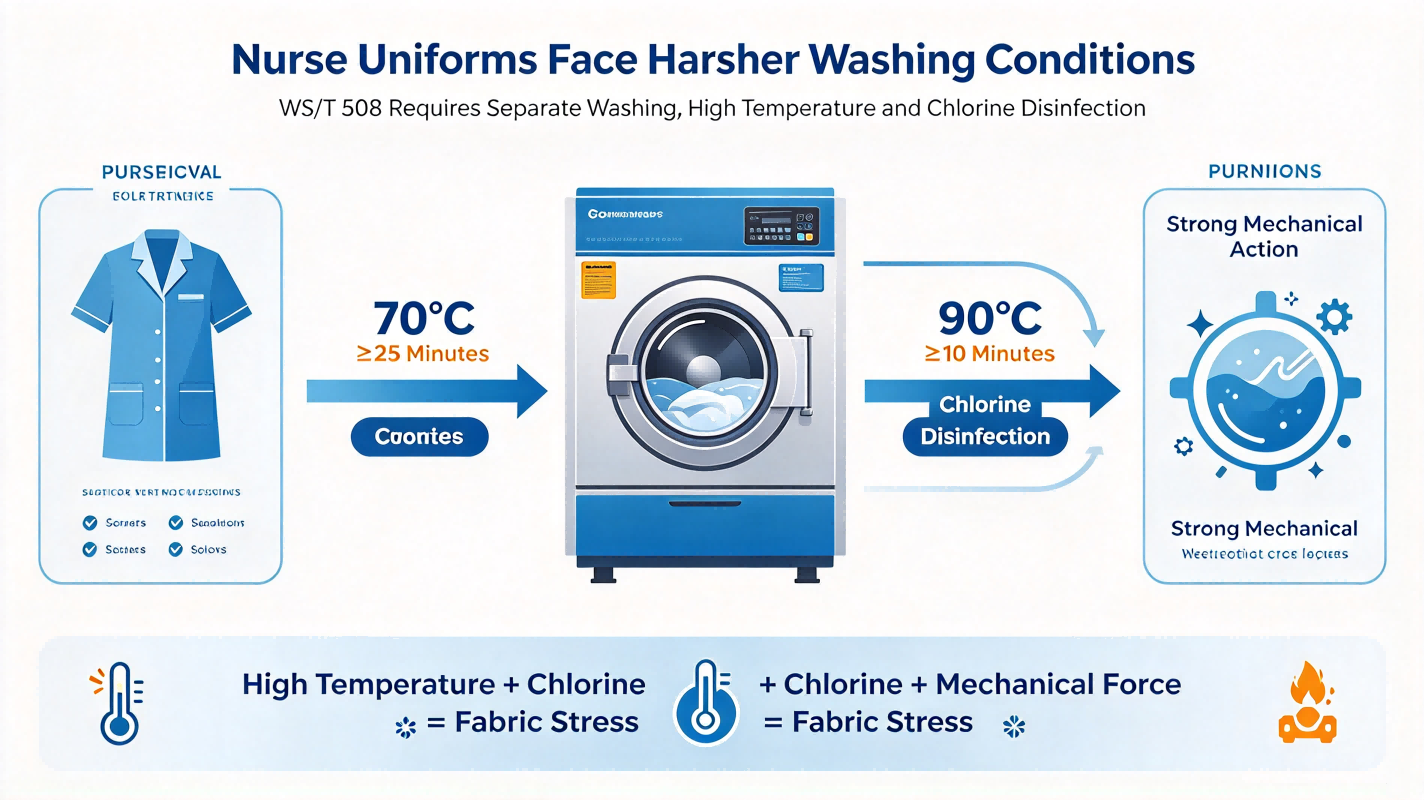
After a nurse uniform has been worn for a while, two problems show up most often – yellowing and stiffening.
A white nurse uniform worn for a month or two starts to yellow at the collar, cuffs, and underarms, and no amount of washing gets it out. A uniform that was soft and comfortable gradually becomes stiff, chafing against the body. Many nurses and laundry staff assume it's simply "not washed clean enough." But the problem is more complicated than that.
Today we're going to break down the causes of yellowing and stiffening in nurse uniforms from two directions – washing/disinfection and finishing. After reading this, you'll know where the problem lies and how to solve it.
1. First, understand: nurse uniforms are washed under completely different conditions from ordinary clothes
Ordinary clothes are washed simply – washing machine, some detergent, hang to dry. Nurse uniforms go through a far more complex process.
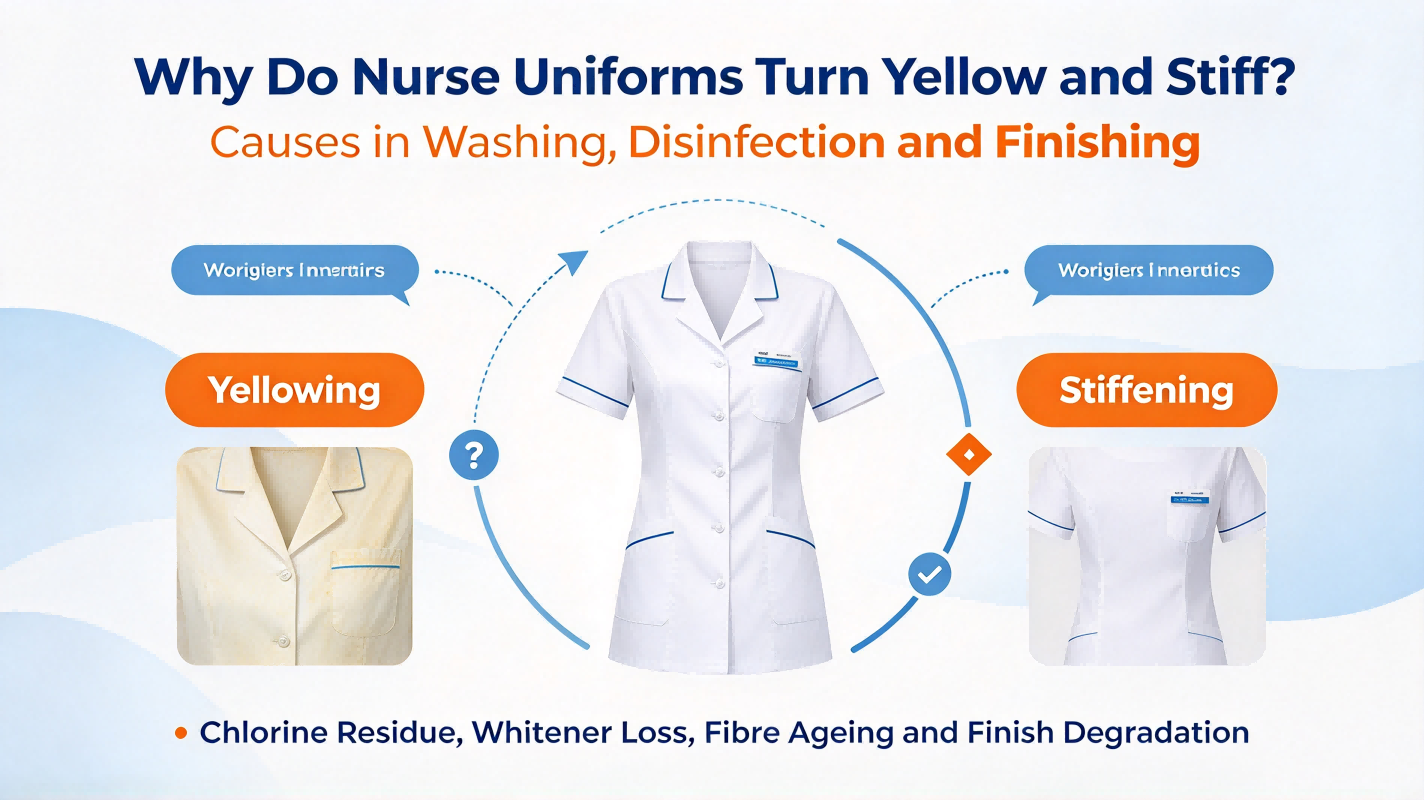
Nurse uniforms are medical textiles, and their washing and disinfection must follow WS/T 508-2016 "Technical Standard for Washing and Disinfection of Medical Textiles in Hospitals." This standard sets clear requirements for the washing process:
First, separate washing. Infectious textiles and ordinary textiles must be washed separately and never mixed.
Second, high-temperature washing. Thermal disinfection requires water temperature above 70°C with a washing time of no less than 25 minutes, or 90°C for no less than 10 minutes. Some scenarios also require an A₀ value of 3000 or above.
Third, chlorine-based disinfection. Many hospital laundries use chlorine-based disinfectants (sodium hypochlorite) for disinfection and bleaching.
Fourth, strong mechanical action. Industrial washing machines have large drums and high rotational speeds – the mechanical force is far stronger than in a household machine.
High temperature, chlorine, and strong mechanical force – put these three together, and it's an enormous test for any fabric. Yellowing and stiffening in nurse uniforms are, to a large extent, the concentrated "side effects" of this washing system.
2. Causes of yellowing: not just "dirt" – it's a chemical reaction
When a white nurse uniform turns yellow, the first reaction is often "it wasn't washed clean." But the reality is – some yellowing gets worse the harder you wash.
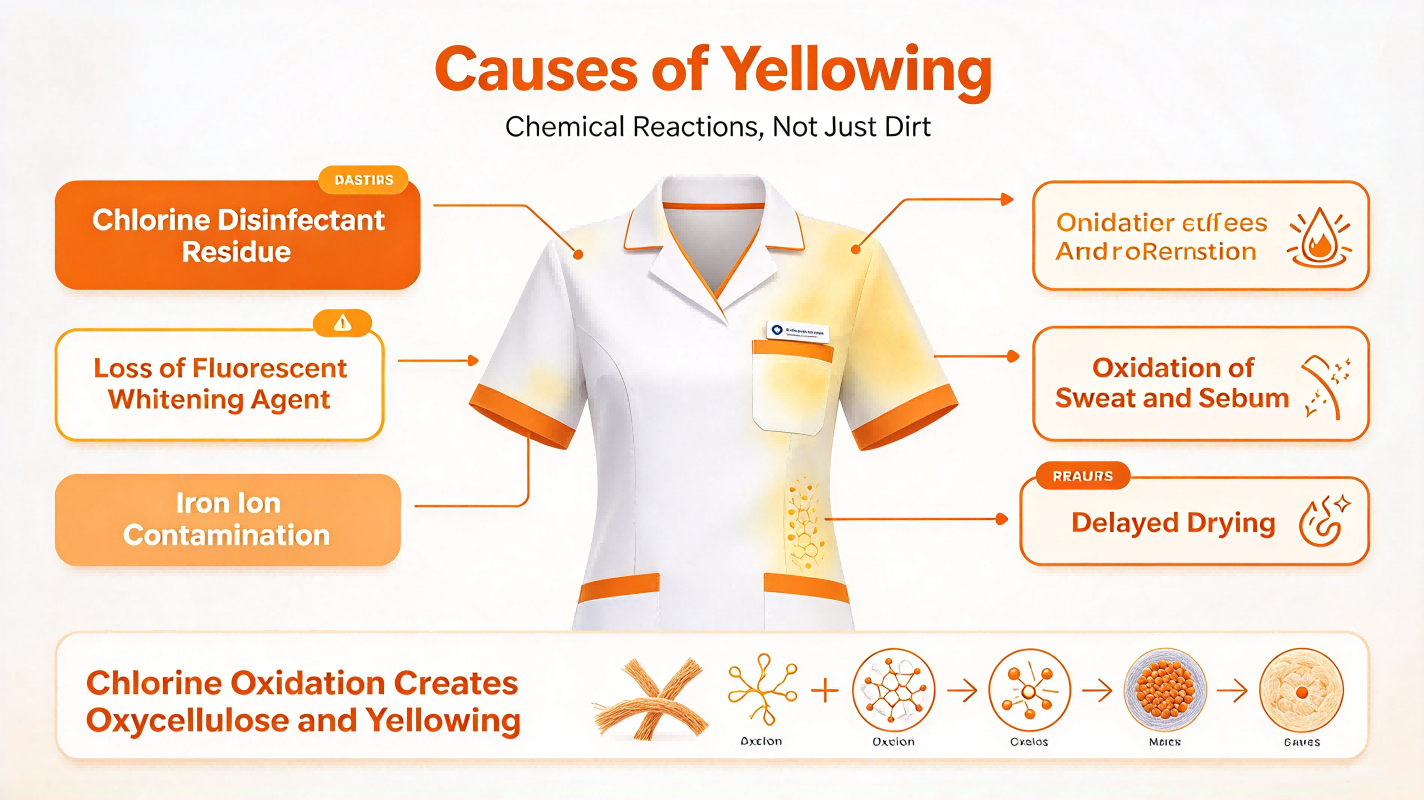
Cause 1: Chlorine disinfectant residue – the number one culprit
This is the most common and most easily overlooked cause of yellowing in nurse uniforms.
Chlorine-based disinfectants (sodium hypochlorite) are strong oxidising agents. They kill bacteria and disinfect, but they also react with cotton fibres through oxidation. The reaction product is oxycellulose, which is itself yellow. If the chlorine disinfectant is overdosed, left on too long, or not thoroughly rinsed, residual chlorine continues reacting on the fabric and causes yellowing.
What's worse, this kind of yellowing is irreversible – once the fibres are oxidised, no amount of washing will whiten them again.
How to tell if the yellowing is caused by chlorine bleaching? Look at where the yellowing appears. If the whole garment yellows evenly, especially at the collar and cuffs where residual disinfectant tends to accumulate, it's basically a chlorine bleaching problem.
Cause 2: Loss of fluorescent whitening agents
Many white nurse uniform fabrics have fluorescent whitening agents added during production. These don't actually make the fabric white – they absorb ultraviolet light and reflect blue light, making the fabric look whiter.
But fluorescent whitening agents gradually wash out. High-temperature washing, chlorine bleaching, and strong mechanical action all accelerate their loss. Once the whitening agent is gone, the fabric returns to its original colour – a yellowish, duller natural tone.
That's why some nurse uniforms "get yellower the more they're washed" – not because they're getting dirty, but because the whitening agent has washed out.
Cause 3: Oxidation of sweat and sebum
Nurse work is physically demanding, and sweating is heavy. Amino acids, urea, and salts in sweat, along with sebum secreted by the skin, adhere to the fabric. These substances aren't yellow themselves, but after oxidation they turn yellow.
This is especially obvious in high-sweat areas like the underarms and collar, where sebum and sweat accumulate and oxidise. If these organic residues aren't thoroughly removed during washing, they gradually set into the fibres and become harder and harder to remove.
Cause 4: Iron ion contamination
This cause is more hidden but does exist.
Iron ions in the wash water, or iron ions introduced by rust in washing machine pipes, react with alkaline components in detergent to form ferric hydroxide – a yellowish-brown precipitate. When this adheres to the fabric, it causes yellowing.
Cause 5: Not drying promptly after washing
If nurse uniforms are left piled in the washing machine after washing, or dried in a damp environment, moisture and residues on the fabric breed bacteria and mould. Some bacterial and mould metabolites are yellowish-brown and can also cause yellowing.
3. Causes of stiffening: the fibres are "getting hurt"
If yellowing is a "chemical problem," stiffening is more the result of "physical and chemical factors working together."
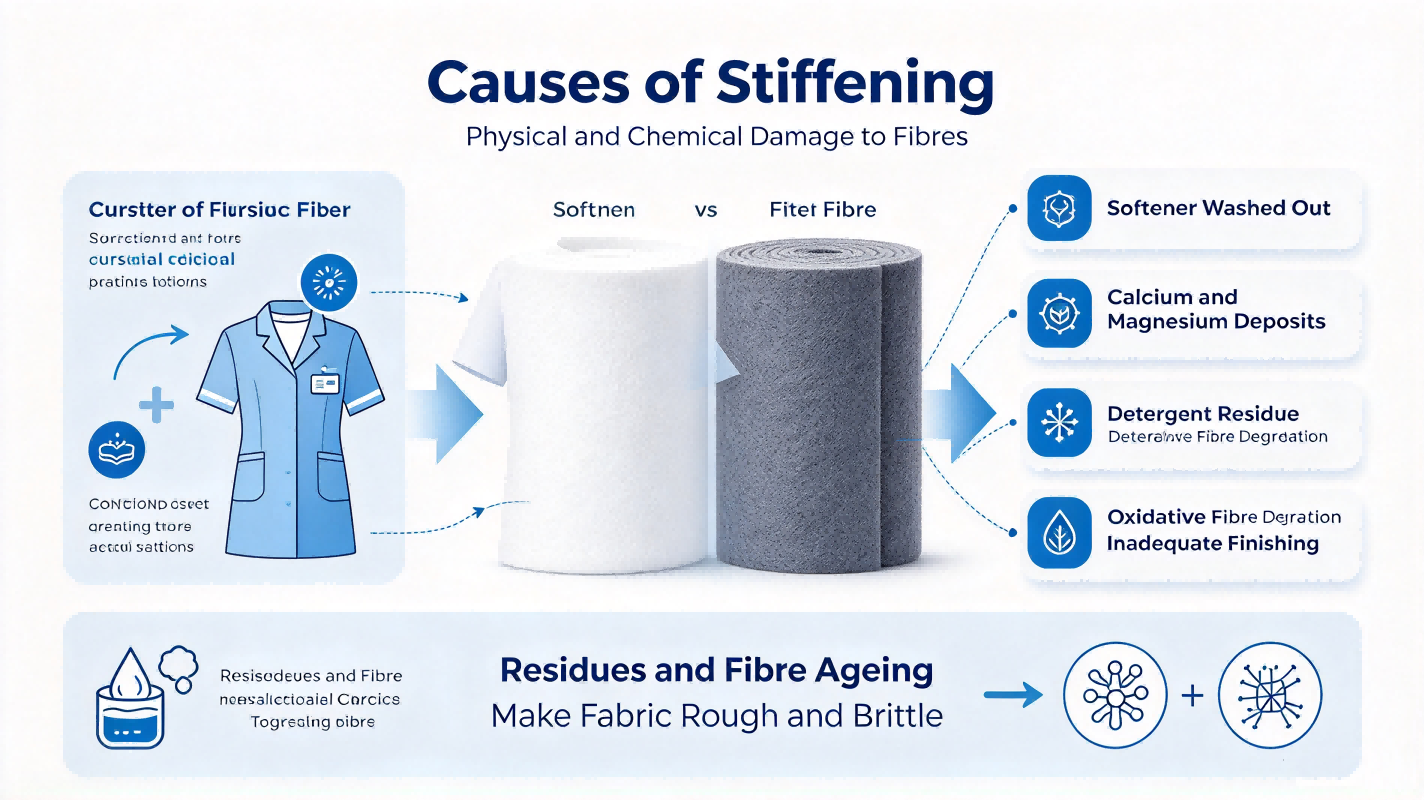
Cause 1: Softener washed out
This is the same principle as with ordinary workwear. Many nurse uniform fabrics are given a soft finish at the factory with softener added. But softener sits on the fibre surface – it isn't permanently fixed inside the fibre.
Nurse uniforms are washed frequently (two or three times a week), and combined with high temperature and strong mechanical action, the softener is lost very quickly. After a dozen or so washes, the softener is basically gone, the fibres return to their natural "hard" state, and the fabric feels rough and stiff.
Cause 2: Calcium and magnesium ion deposits (hard water problem)
If the laundry water is hard, calcium and magnesium ions in the water adhere to the fibres. These ions deposit more easily during high-temperature washing, forming microscopic "scale." As scale accumulates, fibres become brittle and stiff, and the hand-feel deteriorates.
Cause 3: Detergent residue
If washing powder or detergent isn't thoroughly rinsed out, residual surfactants and alkaline components remain in the fibre gaps. After drying, these residues crystallise and stick the fibres together, making the fabric stiff.
If chlorine disinfectant remains, besides causing yellowing, it also makes fibres brittle and stiff.
Cause 4: Oxidative degradation of fibres
High temperature, chlorine, and strong mechanical force – the damage these three do to cotton fibres is cumulative. Once cotton fibres are oxidised, their degree of polymerisation decreases, fibre strength drops, and the hand-feel becomes stiff and brittle. This isn't just a surface hand-feel issue – the fibres themselves are "ageing."
Cause 5: Inadequate finishing
This is something to watch for at the procurement stage.
If the fabric only received a surface soft treatment at the factory (using cheap, non-wash-resistant softener) rather than a durable soft finish, the hand-feel will be gone after a few washes. Legitimate manufacturers apply durable soft finishing, so the soft effect withstands multiple washes. Manufacturers cutting corners skip this step – costs go down, but the uniform stiffens after a few washes.
4. How to solve it? Two steps: "procurement" and "washing/care"
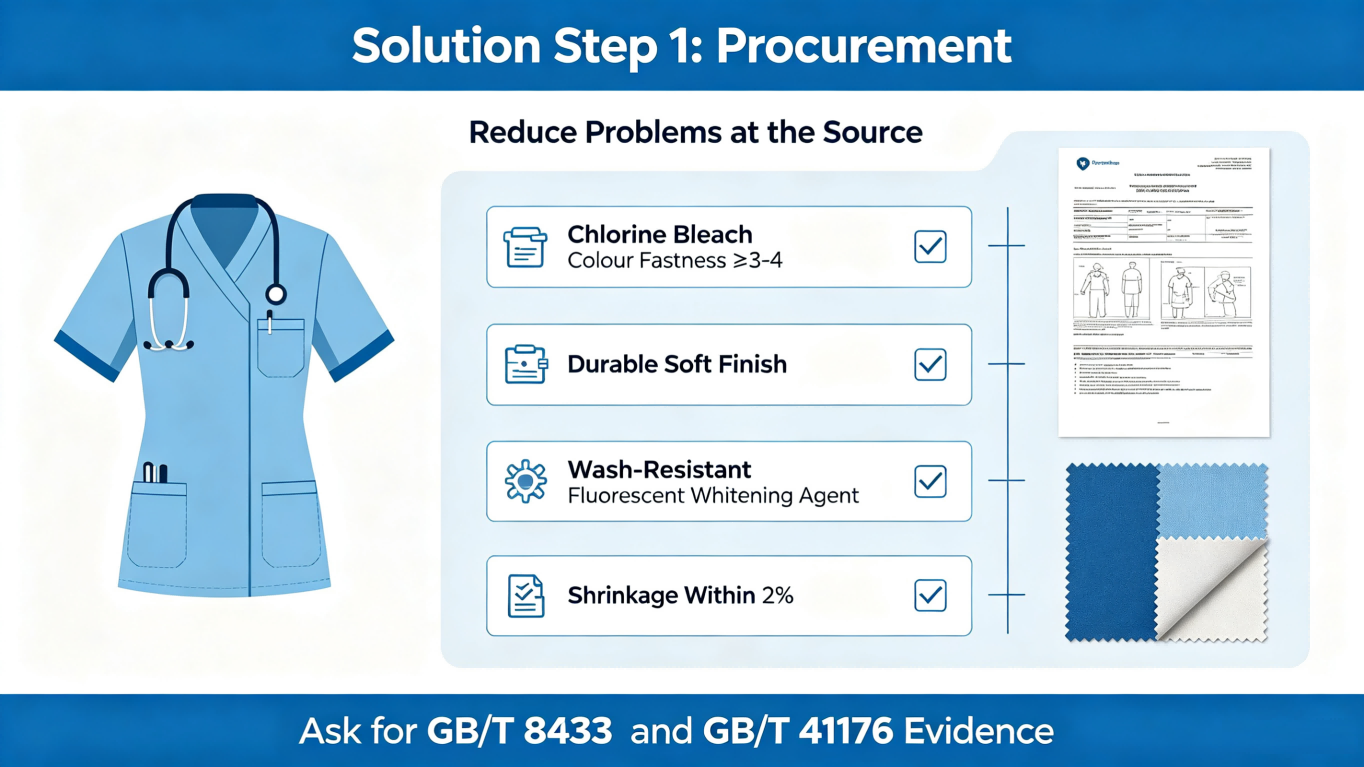
Procurement: choose the right product to reduce problems at the source
First, check the fabric's colour fastness to chlorine bleaching. Ask the supplier for a GB/T 8433 colour fastness to chlorinated water test report, with a grade no lower than 3-4. This is the core indicator that distinguishes nurse uniforms from ordinary workwear, and it directly determines how fast yellowing occurs.
Second, check the finishing process. Ask clearly: Is there a soft finish? Is it surface soft or durable soft? Is there a durable press finish? Surface soft is gone after a few washes; only durable soft can withstand frequent washing.
Third, check the use of fluorescent whitening agents. Ask whether the fabric contains fluorescent whitening agents and how wash-resistant the whitening agent is. If the supplier can't explain clearly, that's a red flag.
Fourth, check shrinkage and dimensional stability. According to GB/T 41176-2021, poly-cotton nurse uniforms should have a shrinkage rate within 2%. Fabric with low shrinkage has good dimensional stability and won't deform easily after washing.
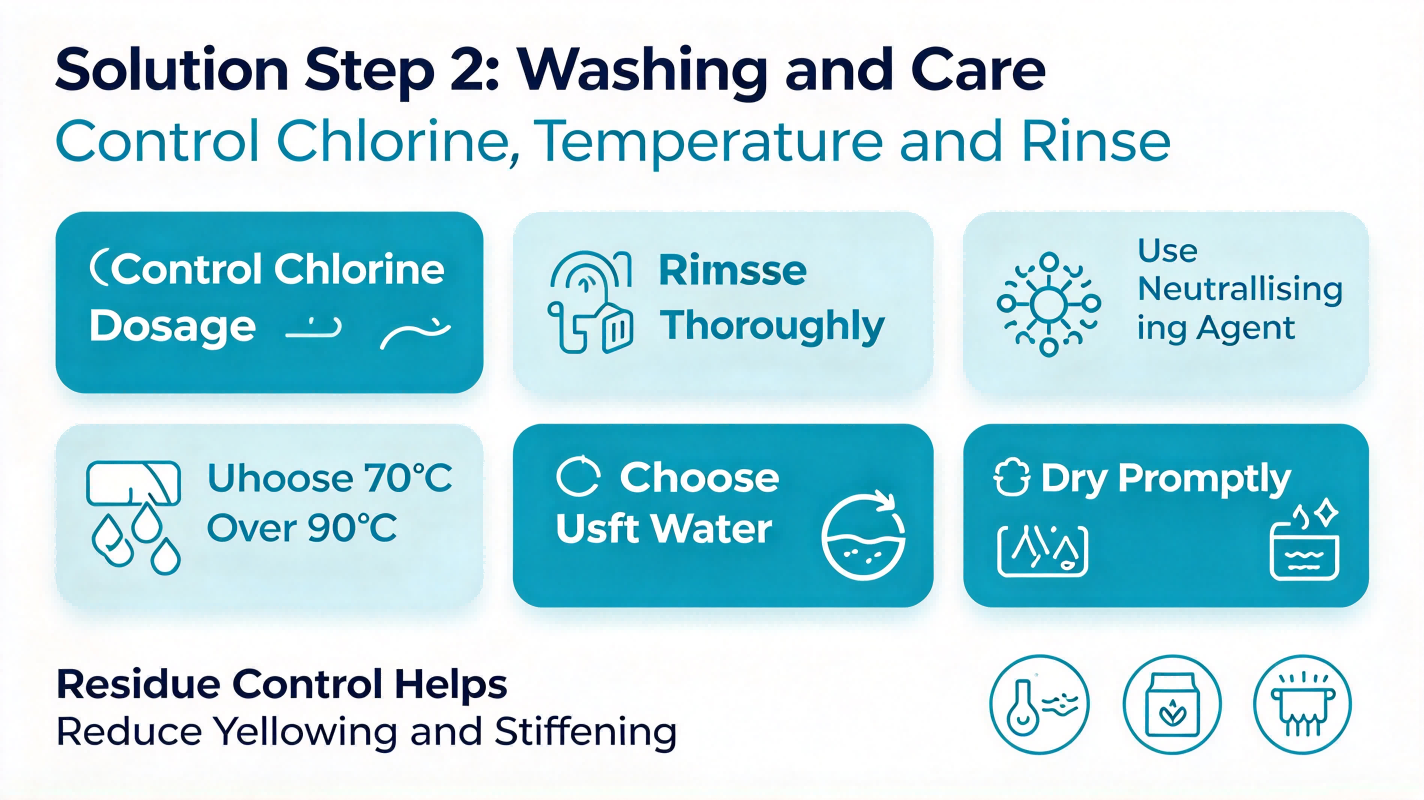
Washing and care: optimise the process to extend service life
First, control the amount of chlorine disinfectant. More chlorine disinfectant isn't better. According to WS/T 508, thorough rinsing after disinfection is required to ensure residual chlorine is completely flushed away. Where conditions permit, laundries can use neutralising agents (such as sodium thiosulphate) to deal with residual chlorine.
Second, control the washing temperature. High-temperature washing is needed for disinfection, but excessively high temperatures accelerate fibre damage. While meeting disinfection requirements, choose 70°C rather than 90°C where possible. Thermal disinfection at 70°C can already achieve an A₀ value of 3000 – there's no need to chase higher temperatures.
Third, wash with soft water. If the laundry water is hard, installing water-softening equipment is recommended. Soft water reduces calcium and magnesium deposits and keeps fabric soft.
Fourth, rinse thoroughly. Run an extra rinse cycle to remove as much detergent and disinfectant residue as possible. Residue is a common accomplice in both yellowing and stiffening.
Fifth, dry promptly. Remove and hang or tumble dry immediately after washing – don't leave uniforms piled in the machine. Damp storage is a breeding ground for bacteria and yellowing.
Sixth, clean the washing machine regularly. If the drum and pipes accumulate dirt and rust, they contaminate nurse uniforms. Cleaning the machine once a month is recommended.
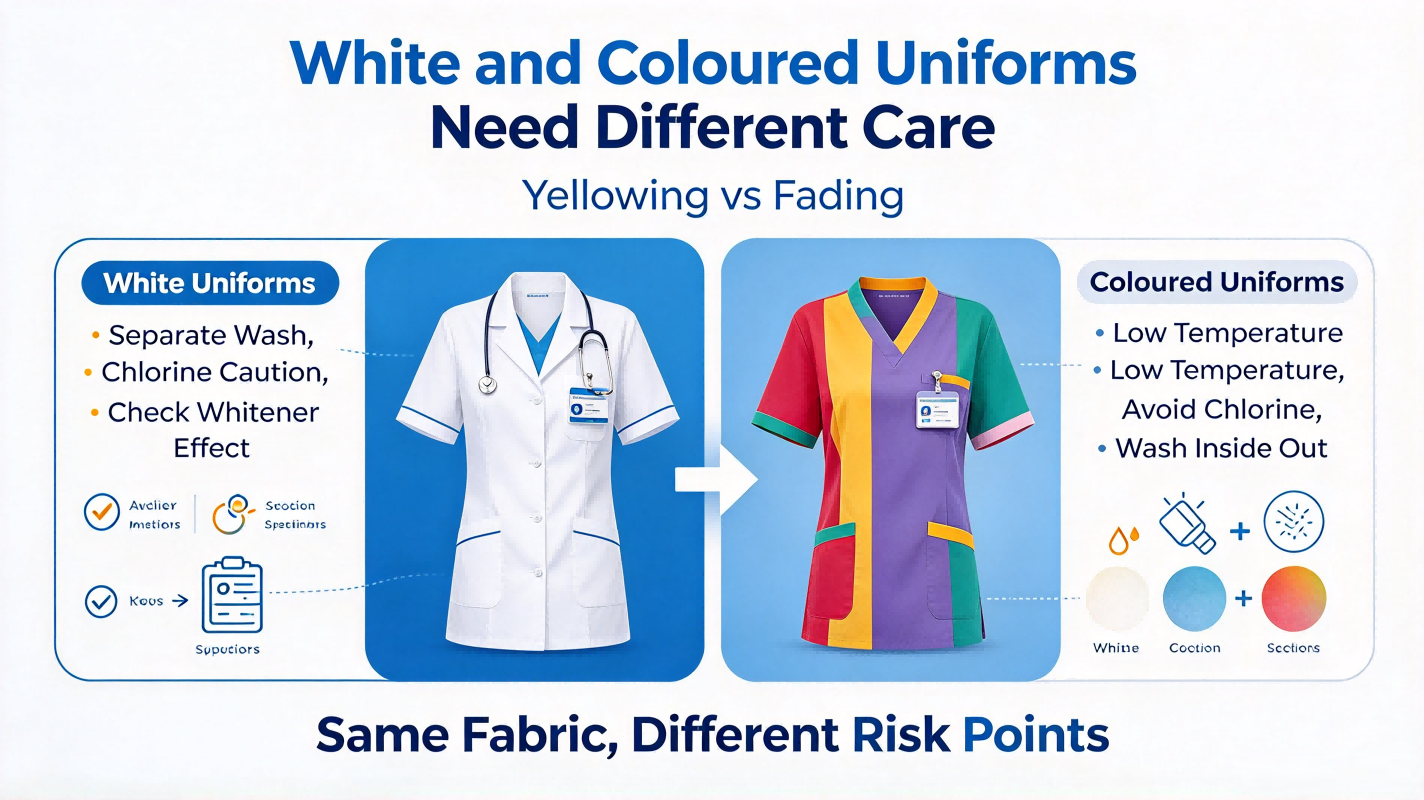
5. An easily overlooked detail: white and coloured nurse uniforms need different care
White nurse uniforms are most sensitive to yellowing because any yellowing is visible to the naked eye. Pay special attention:
Coloured nurse uniforms (light blue, light pink, light green) don't have a "yellowing" problem, but fading is the main risk. For coloured uniforms:
6. A summary table: causes and countermeasures for yellowing and stiffening
|
Problem |
Main cause |
Procurement countermeasure |
Washing/care countermeasure |
|
Yellowing |
Oxidation from chlorine disinfectant residue |
Require chlorine bleach colour fastness ≥3-4 |
Control dosage, rinse thoroughly, use neutralising agent |
|
Yellowing |
Loss of fluorescent whitening agent |
Ask about wash resistance of whitening agent |
Use garment whitening agent periodically |
|
Yellowing |
Oxidation of sweat and sebum |
Choose easy-clean fabric |
Pre-treat collar and cuffs, wash thoroughly |
|
Yellowing |
Iron ion contamination |
— |
Clean washing machine, use soft water |
|
Stiffening |
Softener washed out |
Choose durable soft finish fabric |
Use softener moderately (except functional workwear) |
|
Stiffening |
Calcium/magnesium deposits |
— |
Wash with soft water |
|
Stiffening |
Detergent residue |
— |
Rinse thoroughly |
|
Stiffening |
Oxidative degradation of fibres |
Choose chlorine-bleach and high-temp resistant fabric |
Control temperature, reduce chlorine dosage |
|
Stiffening |
Inadequate finishing |
Ask about finishing process |
— |
A final honest word
Yellowing and stiffening in nurse uniforms isn't as simple as "not washed clean enough." Behind it is the combined effect of oxidation by chlorine disinfectants, loss of fluorescent whitening agents, fibre ageing, and degradation of finishing.
When buying, don't just ask "How much per piece?" Ask directly: "What's the chlorine bleach colour fastness? Is there a durable soft finish? How wash-resistant is the fluorescent whitening agent?" – A supplier who can answer these questions clearly is a supplier who truly understands nurse uniform fabric.
When washing, don't just think "more disinfection, more bleaching." Control chlorine dosage, rinse thoroughly, use soft water, and dry promptly – get these right, and you'll alleviate at least half of the yellowing and stiffening problems.
Nurse uniforms are the battle gear that nurses wear every day, wash every week, and put through high-temperature chlorine bleaching. Choose the right fabric and use the right washing methods, and they'll last longer and stay comfortable to wear.