What Are You Looking For?

Trap 1: Focusing only on unit price, not total cost of ownership
This is the most common and most insidious trap.
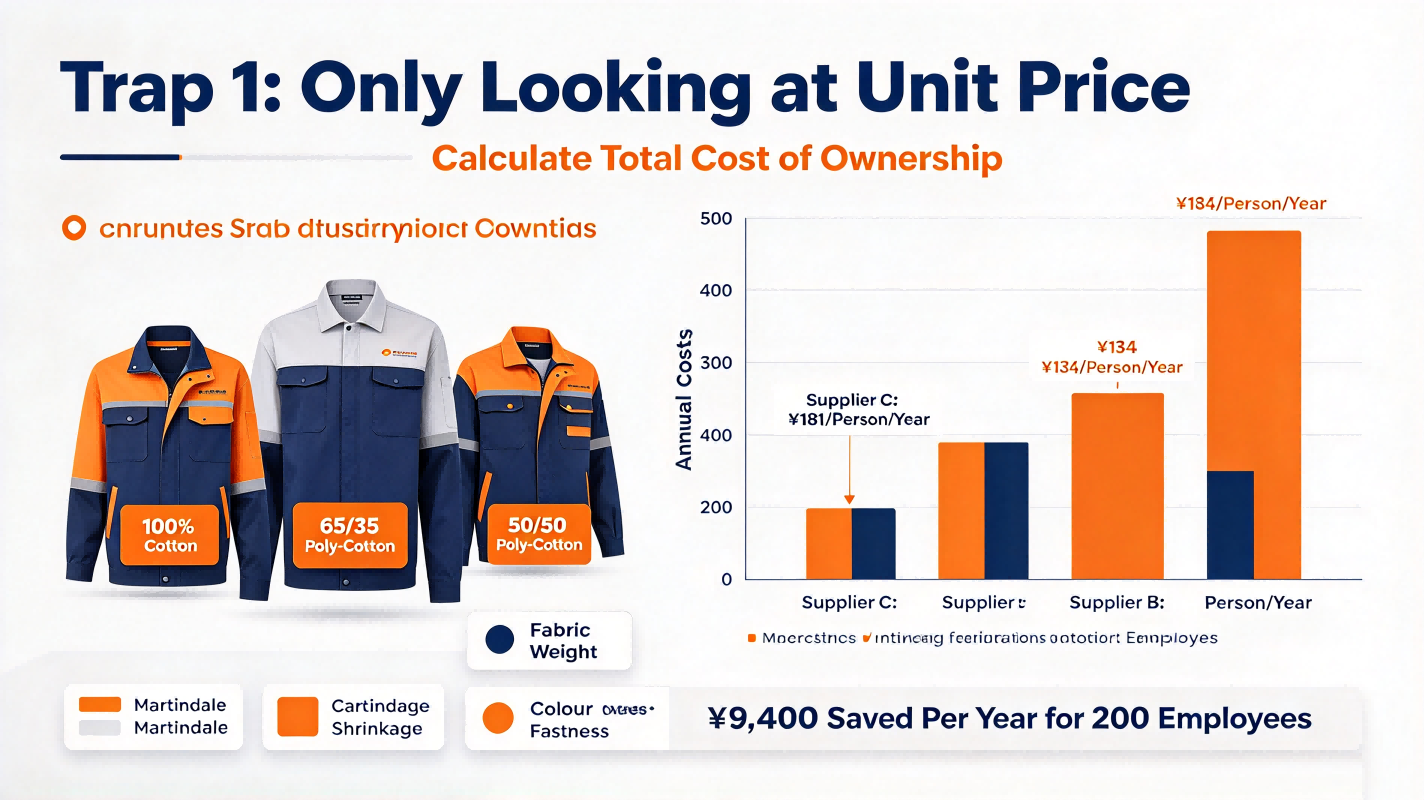
You get three quotes: Supplier A's 100% cotton workwear at 98 yuan per set, Supplier B's 65/35 poly-cotton at 72 yuan per set, and Supplier C's 50/50 poly-cotton at 58 yuan per set. Many people pick Supplier C immediately because the unit price is the lowest. But a year later, the total bill tells a different story – Supplier C's uniforms start pilling, fading, and splitting at the seams after fewer than 20 washes. Each employee goes through three sets in 18 months. Supplier B's uniforms are still going strong after 50 washes—one set lasts a year and a half. Supplier A costs more, but employee satisfaction is highest, and turnover is lowest.
Let's do the math:
Suppose a company has 200 employees, each issued two summer sets and two spring/autumn sets.
- Supplier C: Summer 58 yuan/set × 2 + Spring/autumn 78 yuan/set × 2 = 272 yuan per person per year. But because they don't last, the whole company replaces them every 1.5 years on average—annual cost about 181 yuan per person.
- Supplier B: Summer 72 yuan/set × 2 + Spring/autumn 95 yuan/set × 2 = 334 yuan per person per year. But they last 2.5 years – annual cost about 134 yuan per person.
Supplier B's unit price is 62 yuan higher, but the annual cost is 47 yuan per person lower. For a 200-person company, that's 9,400 yuan saved per year. That's not even counting the procurement team's time spent reordering and the productivity loss from ill-fitting uniforms.
How to avoid it:
Don't just look at "yuan per set" – calculate "yuan per person per year." Specifically: ask suppliers for hard indicators like fabric weight, yarn count, density, abrasion resistance (Martindale cycles), shrinkage rate, and colour fastness grade. The higher the indicators, the longer the service life. For the same 65/35 poly-cotton, 210 gsm and 260 gsm differ by half in lifespan. For the same 100% cotton, 32s yarn and 21s yarn wear completely differently.
Remember one thing: the cost of workwear isn't how much you pay when you buy it – it's how much you pay each year when it's worn.
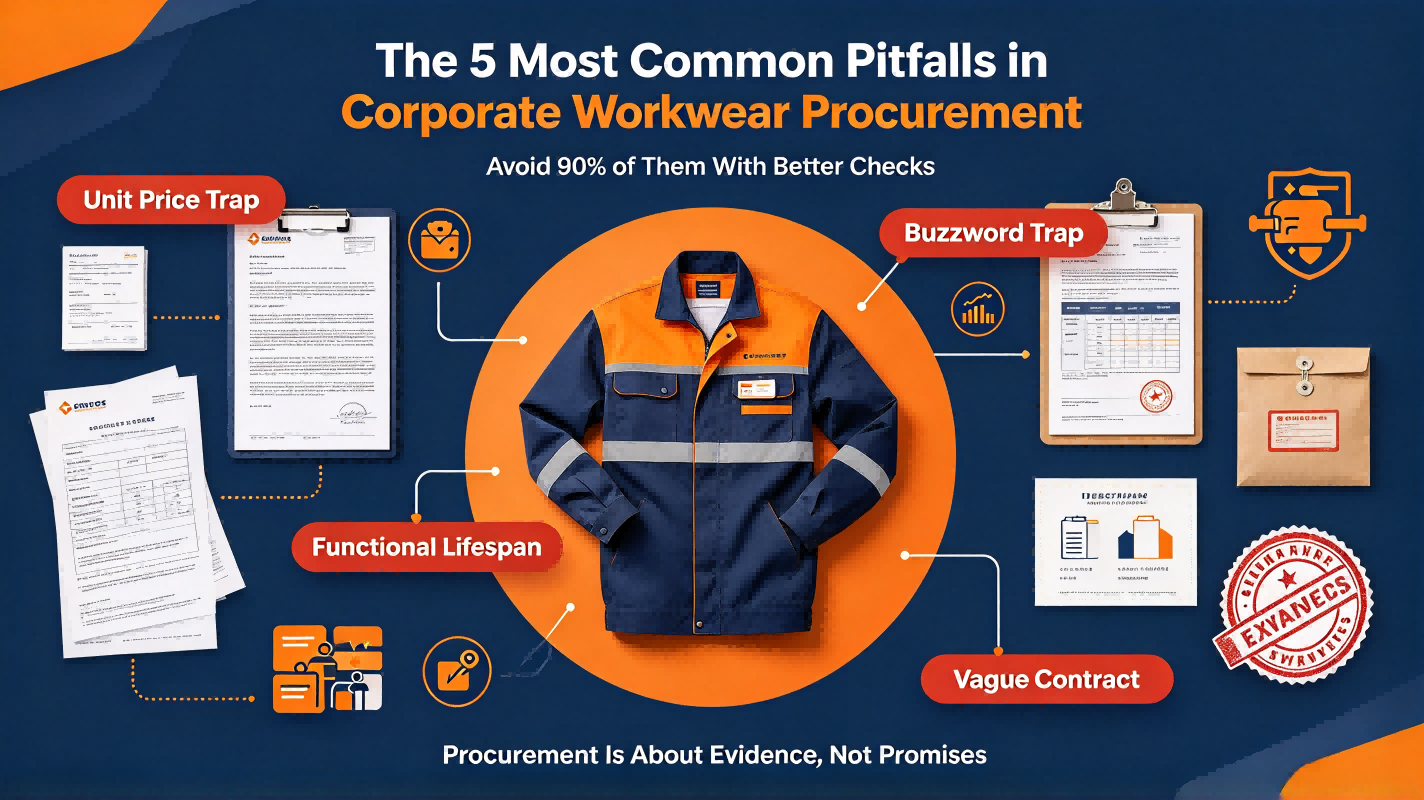
Trap 2: Not checking standards, getting fooled by buzzwords
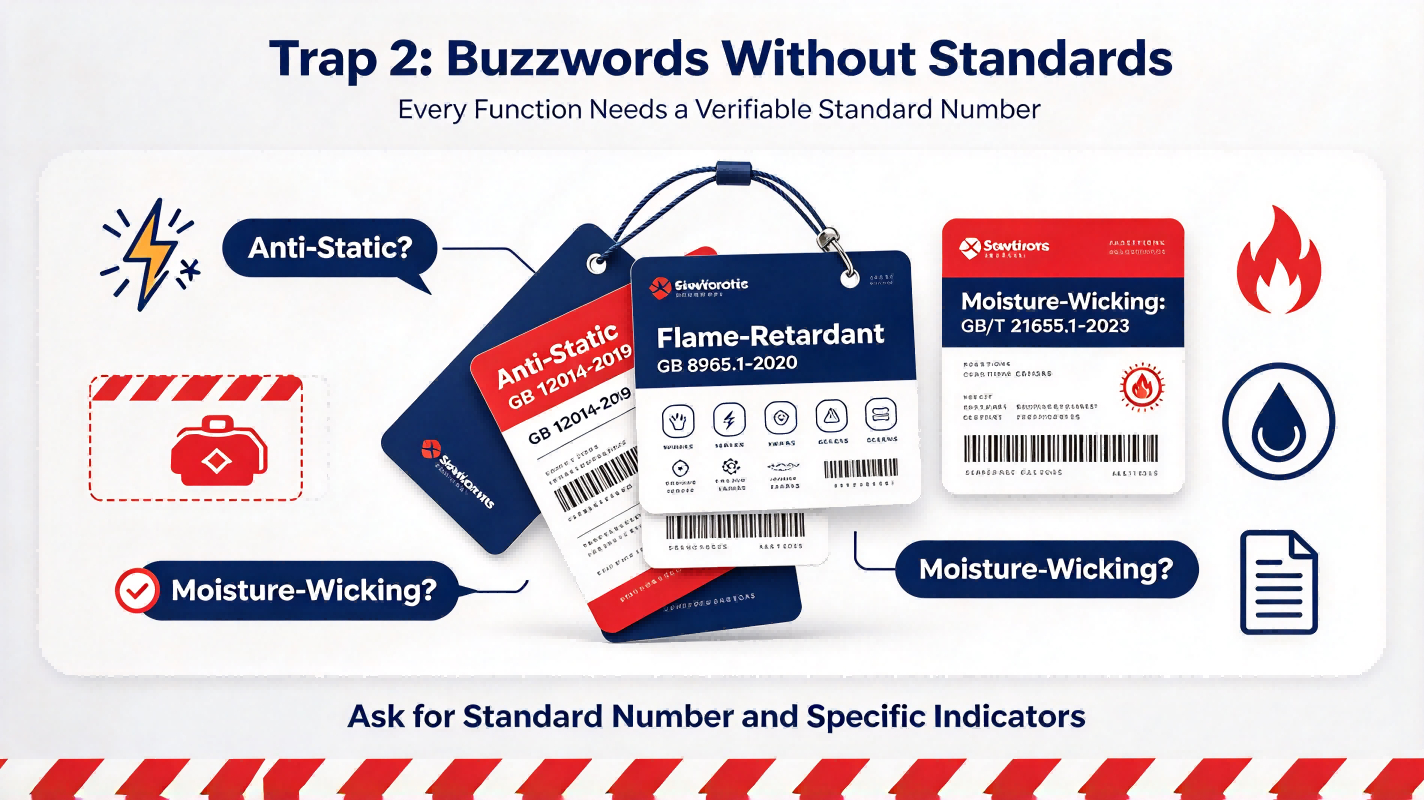
"We're anti-static." "This is flame-retardant." "This is moisture-wicking." Do these words from suppliers have any basis?
Workwear functionality isn't something you can just talk about – every function has a corresponding national standard. If you don't check the standard when buying, you're handing your money over to a promise with no accountability.
Common scenarios:
A supplier says "anti-static," but the tag shows an ordinary garment standard, not GB 12014. A supplier says "flame-retardant," but it's actually "treated flame retardancy" – the effect fades noticeably after 50 washes, and since uniforms are washed two or three times a week, it fails within six months. A supplier says "moisture-wicking," but the fabric is 100% polyester, which doesn't absorb water at all.
How to avoid it:
Remember three core standard numbers and ask directly:
- Anti-static clothing: Does it comply with GB 12014-2019? What's the surface resistance? What's the charge quantity? What's the performance retention after 50 washes?
- Flame-retardant clothing: Does it comply with GB 8965.1-2020? Is it Level A or Level B? Is it inherent or treated flame retardancy? Do you have a post-wash flame-retardant performance report after 50 washes?
- Moisture-wicking quick-dry: Does it comply with GB/T 21655.1-2023? What are the water absorption rate, drop diffusion time, and drying rate?
Being able to ask for standard numbers and specific indicators tells the supplier you're not easily fooled. If they can't provide a standard number, skip them.
Trap 3: Samples don't match bulk production
This is one of the most frustrating traps.
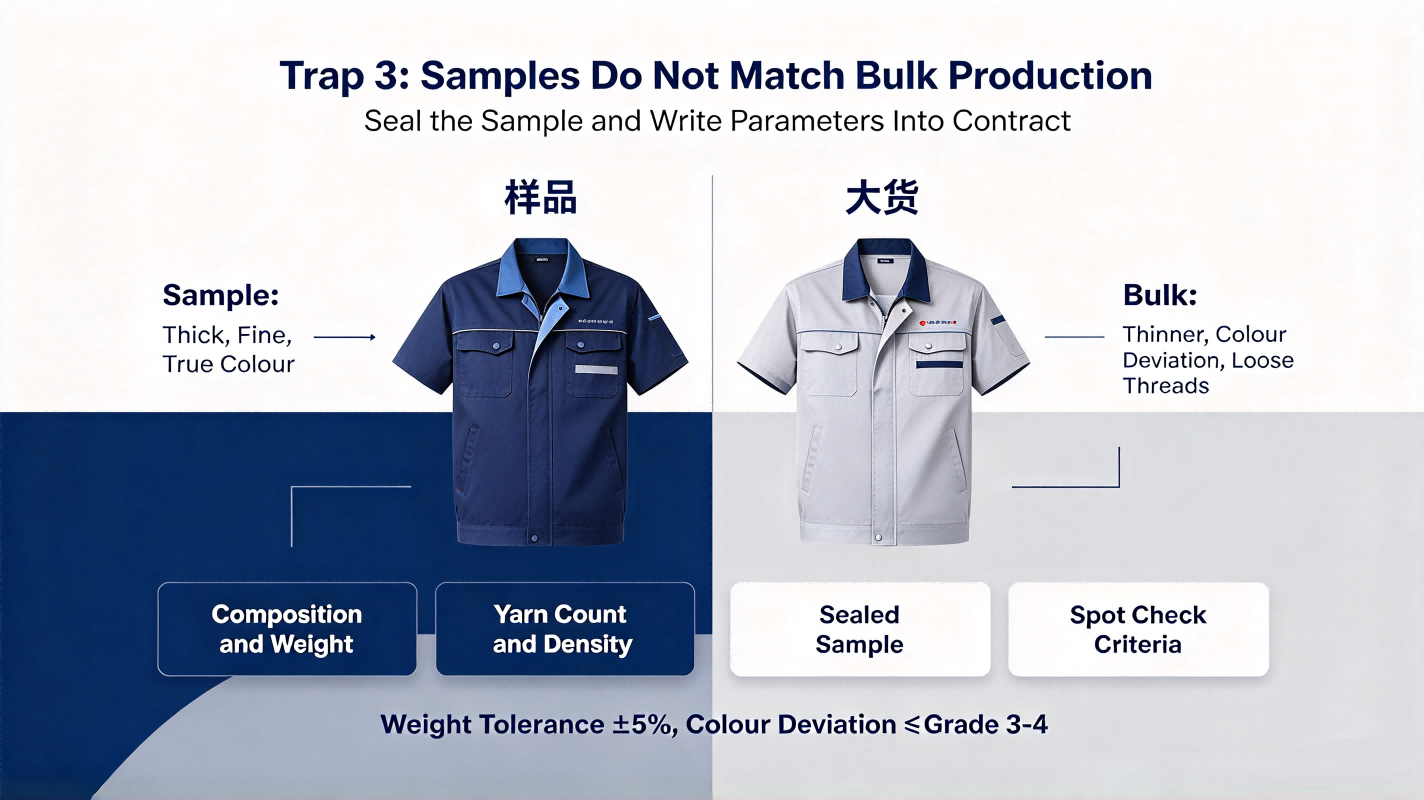
The sample arrives: thick fabric, fine workmanship, true colour. Then the bulk order arrives: the fabric is thinner, the colour is off, and loose threads are everywhere. You go back to the supplier, and they say, "Different batches – slight variations are normal."
There's a difference between slight variation and serious shrinkage.
How to avoid it:
First, write key parameters into the contract. Fabric composition, weight (allow ±5% tolerance), yarn count, density, colour fastness grade, shrinkage range—all written into the contract annex. Don't just write "65/35 poly-cotton." Write "65/35 poly-cotton, 240 gsm (±5%), yarn count 32×32, density 130×70."
Second, keep a sealed sample. After confirming the sample, both parties sign and seal it, each keeping one copy. When the bulk order arrives, randomly sample from each batch and compare it with the sealed sample. Comparison items include: weight, colour (using a colour card), hand-feel, seam strength.
Third, agree on acceptance criteria. Specify a clause like "if spot checks fail, the entire batch is returned." For example: randomly inspect 10 pieces; if 3 or more are below 95% of the contract weight, or if colour deviation exceeds grade 3-4 on the GB/T 250 scale, reject the entire batch.
Fourth, arrange a mid-production inspection. You don't need to go every time, but for the first bulk order, send someone to the factory to look at the fabric warehouse and production line. Whether the fabric you see matches the sample will tell you most of what you need to know.
Trap 4: Ignoring the "functional lifespan" of performance fabrics
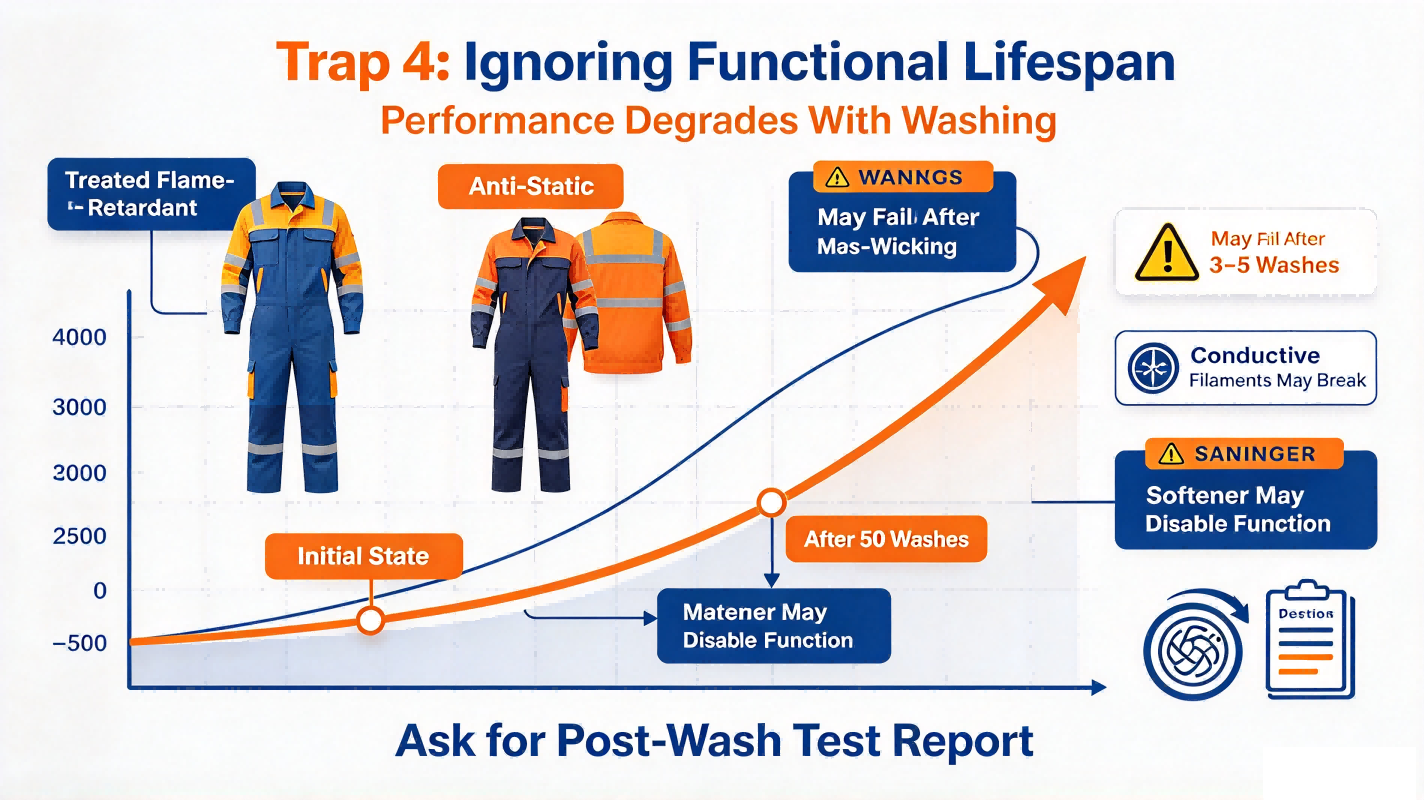
Many buyers only ask "is it flame-retardant?" but never ask "how long does the flame retardancy last?" They only ask "is it anti-static?" but never ask "will it still be anti-static after 50 washes?"
Functionality has a lifespan.
Treated flame-retardant fabric degrades noticeably after 50 washes; some inferior products fail after just 3 washes. The conductive filaments in anti-static clothing may break after dozens of washes, causing surface resistance to exceed the standard range and the anti-static function to drop to zero. Moisture-wicking fabric, if washed improperly (say, with fabric softener), has its hydrophilic layer coated over, and the quick-dry function disappears entirely.
How to avoid it:
When buying functional workwear, you must ask three questions:
First, how many washes will this function survive? Ask the supplier for a test report after 50 washes, not just an initial test report.
Second, are there special washing requirements? Anti-static clothing cannot use fabric softener; flame-retardant clothing cannot use chlorine bleach; moisture-wicking fabric cannot use strong alkaline detergent. These requirements must be written into the employee care guide.
Third, is there a recommendation for periodic testing? Anti-static clothing should be retested for surface resistance every 6 to 12 months; treated flame-retardant clothing should be sent for flame-retardant testing every 30 to 40 washes. During procurement, you can ask the supplier to provide these testing services, or agree on who bears the testing cost.
One sentence: functional workwear isn't "buy once and forget it"—you need to calculate its "functional lifespan."
Trap 5: No contract, or vague contract terms
Many companies buy workwear in relatively small amounts, think "no need for a contract," or just sign a template without thinking. When problems arise, they find that nothing in the contract is clear.
Common contract loopholes:
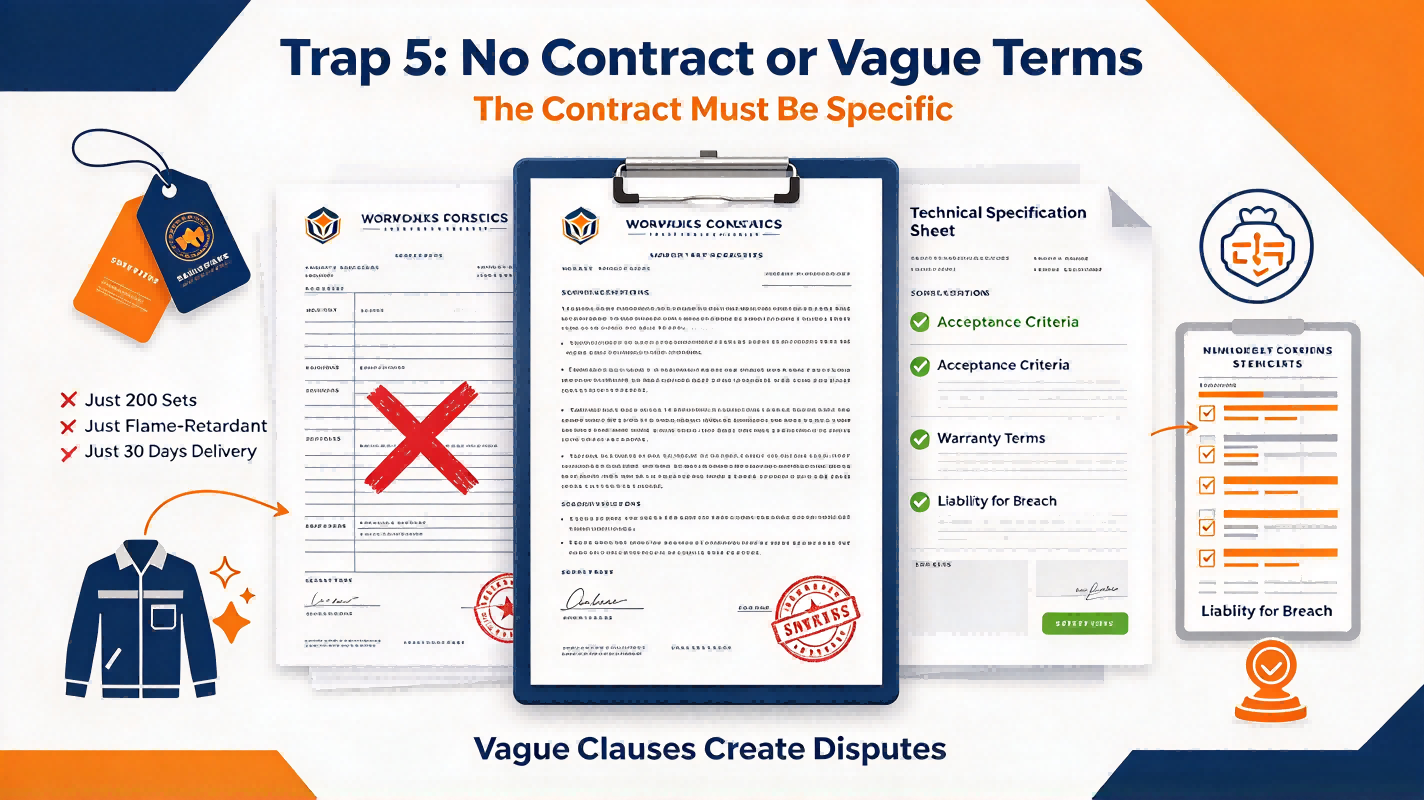
- Only says "200 sets of poly-cotton workwear," without weight, yarn count, density, or colorfastness grade.
- Only says "flame-retardant clothing," without execution standard, protection level, or whether it's inherent or treated flame retardancy.
- Only says "delivery within 30 days," without penalty for late delivery.
- Only says "one-year warranty," without specifying what problems qualify for return or exchange during the warranty period, or what the process is.
How to avoid it:
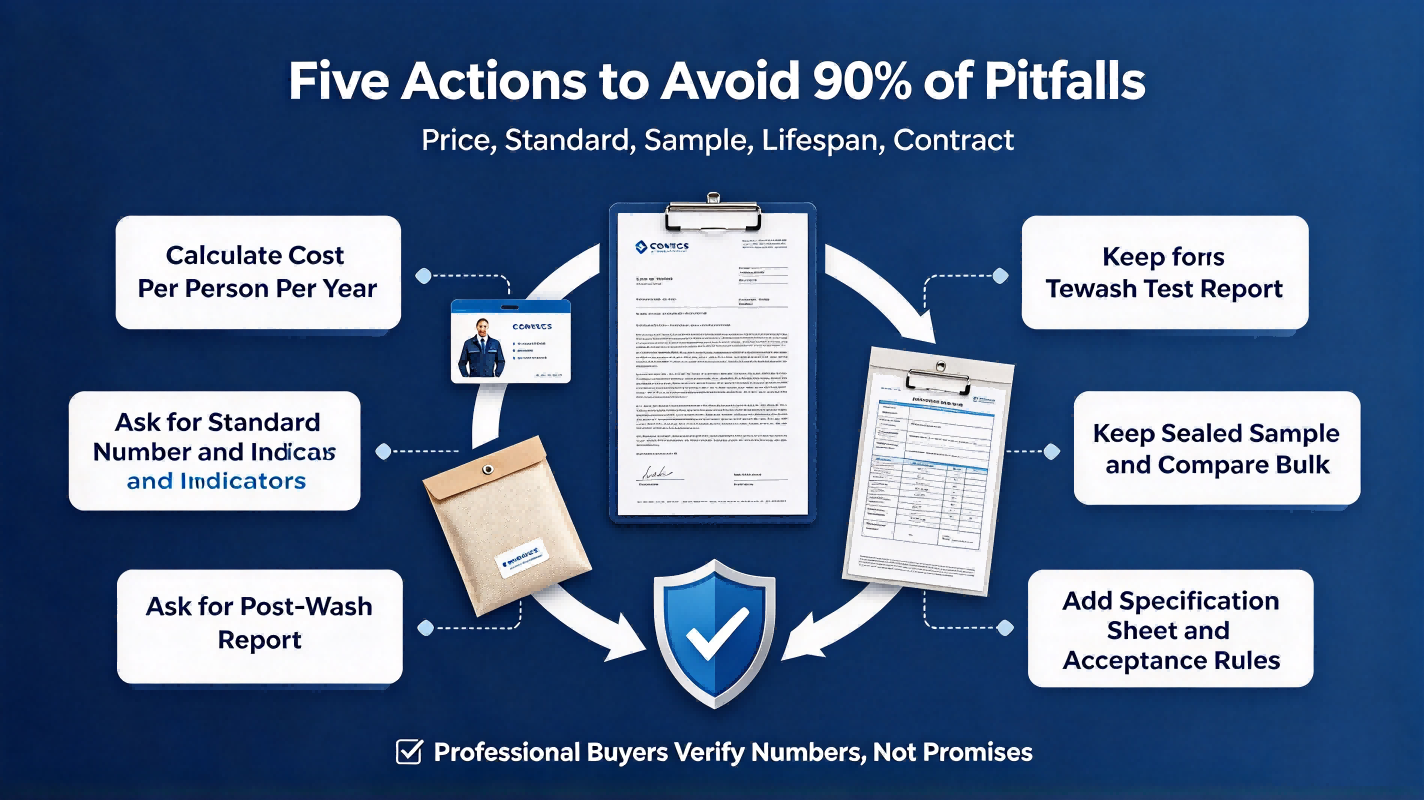
First, the contract must include a technical specification sheet. List fabric composition, weight, yarn count, density, colour fastness, shrinkage, and functional indicators (if any). The specification sheet has the same legal effect as the contract.
Second, agree on acceptance criteria and procedures. Specify the sampling ratio, inspection items, and how non-conforming products are handled (return, exchange, deduction).
Third, agree on warranty and after-sales terms. If workwear has quality problems not caused by human damage (such as seam splitting, severe fading, or functional failure), the supplier should replace it free of charge within a certain number of days.
Fourth, agree on liability for breach of contract. Late delivery: pay a penalty per day as a percentage of the total contract value. Failed spot check: return the entire batch, with the supplier bearing round-trip shipping.
Fifth, keep communication records. WeChat chats, email confirmations, sample photos—save them all. If a dispute arises, these are evidence.
A final honest word
Workwear procurement isn't as simple as "compare prices and place an order." It involves fabric, standards, functions, contracts, and acceptance—every step has pitfalls.
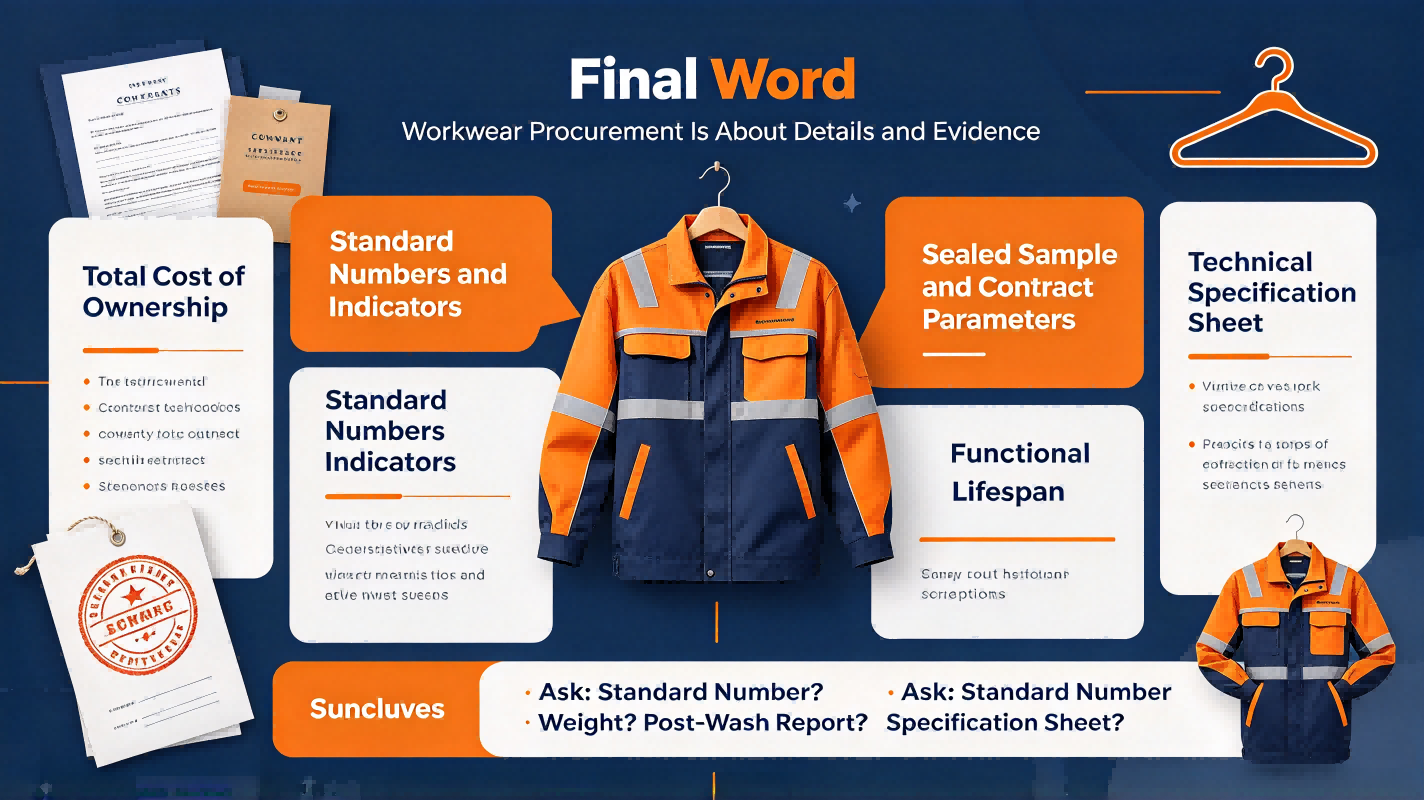
But if you remember five things, you can avoid 90% of them:
First, calculate the total cost of ownership, not just the unit price.
Second, ask for standard numbers and specific indicators, not just concepts.
Third, keep sealed samples and write key parameters into the contract.
Fourth, for functional workwear, ask about "functional lifespan" and request post-wash test reports.
Fifth, attach a technical specification sheet to the contract and agree on acceptance. criteria and liability for breach.
Next time a supplier comes to quote, ask them directly: "What's the execution standard? What's the weight? Do you have a test report after 50 washes? Can the contract include a technical specification sheet?" – being able to ask those questions tells the supplier you're not just a buyer comparing prices, but a professional who actually knows the industry.