What Are You Looking For?


When buying nurse uniforms, colour is the first thing you have to decide.
Choose white—classic, clean, and strongly professional, but it shows dirt easily, is hard to wash, and yellowing is very obvious. Choose colour – more dirt-resistant, livelier, and gives departments higher recognition, but choose the wrong colour and it looks unprofessional; after a few washes, it may fade or go blotchy.
More importantly, nurse uniform colour isn't just about "looking good." Many hospitals use colour for clear departmental identification. What colour A&E wears, what colour paediatrics wears, what colour ICU wears—there's an established logic behind it. Choose the wrong colour, and at best nurses are uncomfortable; at worst, it affects patient recognition and hospital management.
Today, we're going to explain nurse uniform colors clearly—the pros and cons of white and colour, how different departments use colour for identification, and what to watch out for during procurement.
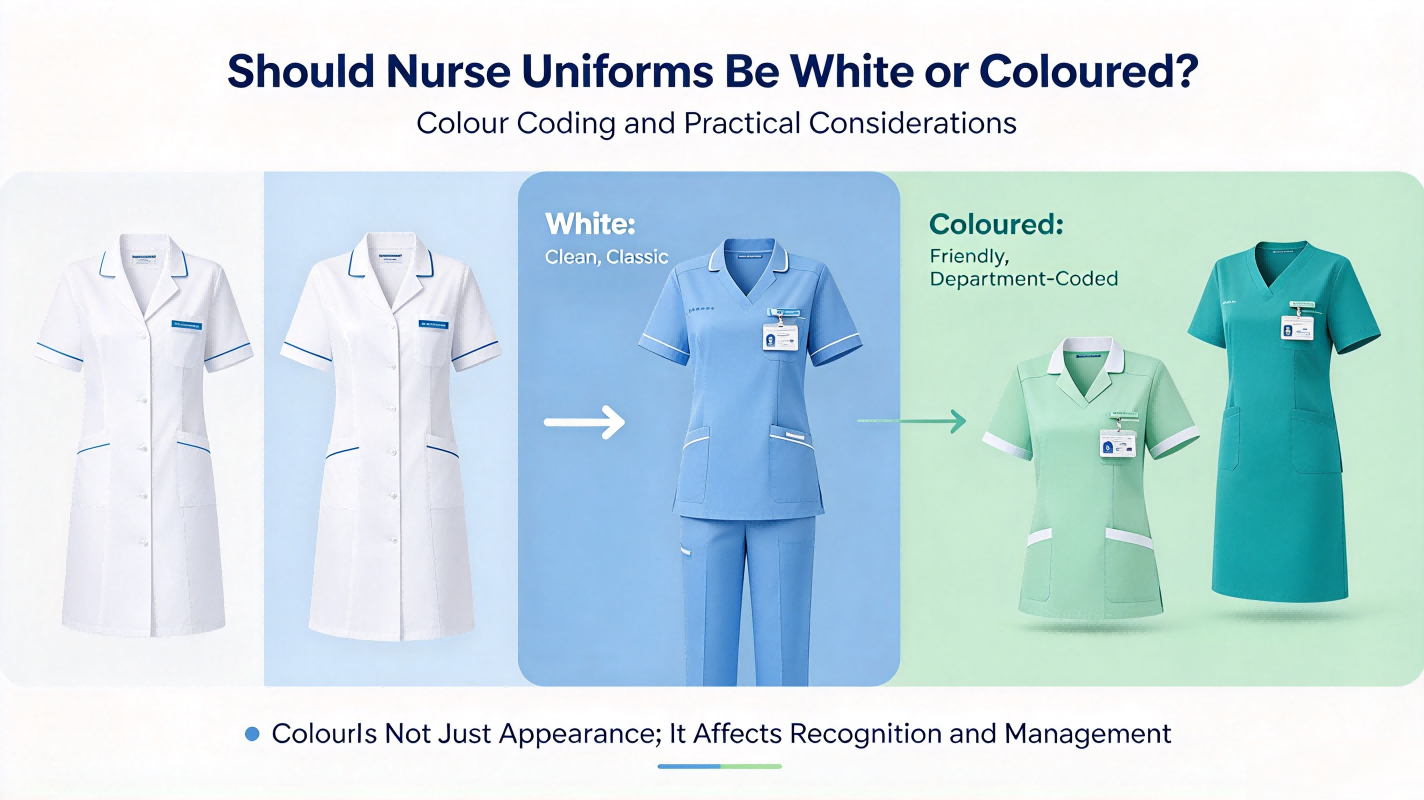
1. First, understand: why are nurse uniforms traditionally white?
White nurse uniforms weren't chosen at random.
First, white represents cleanliness. Since the era of Florence Nightingale, the founder of modern nursing, white nurse uniforms have symbolised "clean, sterile, professional." White shows stains most easily, forcing nurses to keep their uniforms clean and making it easy for managers to check hygiene standards.
Second, white is easy to disinfect and bleach. Hospital laundries use chlorine-based disinfectants for bleaching. White fabric doesn't fade—no matter how much you bleach it, it stays white. Coloured fabric bleached with chlorine quickly goes blotchy.
Third, white is uniform and doesn't distract. Hospital environments need to be quiet and orderly. White nurse uniforms are visually unobtrusive and don't distract patients or families.
But the downsides of white nurse uniforms are also obvious:
First, they don't resist dirt. A small stain, a drop of medicine, a spot of blood—all clearly visible on white. After a busy day, a nurse's uniform is covered in "traces of work."
Second, yellowing is a prominent problem. White nurse uniforms yellow at the collar and cuffs over time and with repeated washing. After the fluorescent whitening agent washes out, the whole garment looks dull. This was covered in detail in the previous article and is the biggest pain point of white nurse uniforms.
Third, psychological pressure on nurses. White shows dirt so easily that nurses constantly worry about their uniforms getting dirty and looking bad—a psychological burden at work. Especially in paediatrics and psychiatry, where accidental stains are common, the practicality of white nurse uniforms is greatly reduced.
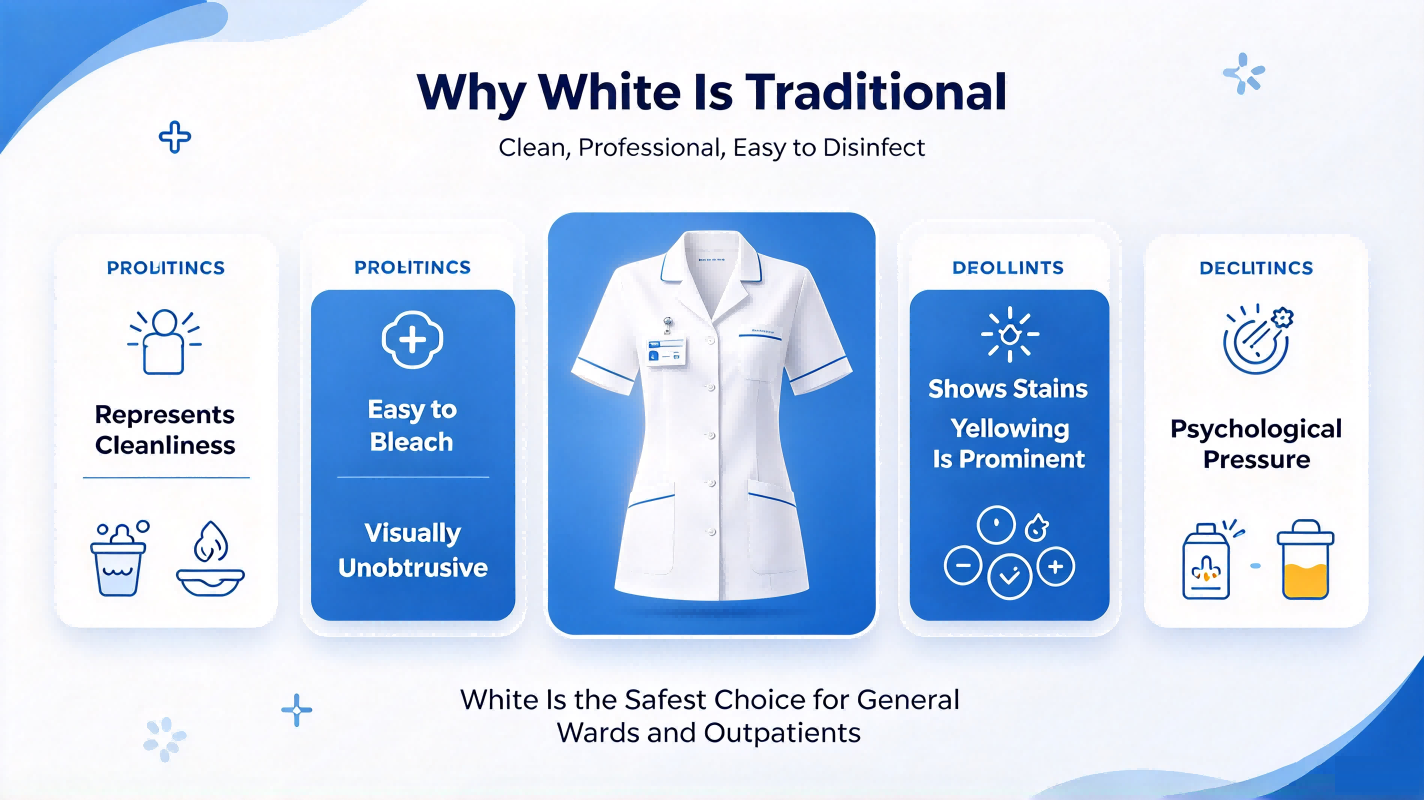
2. Why are coloured nurse uniforms becoming more popular?
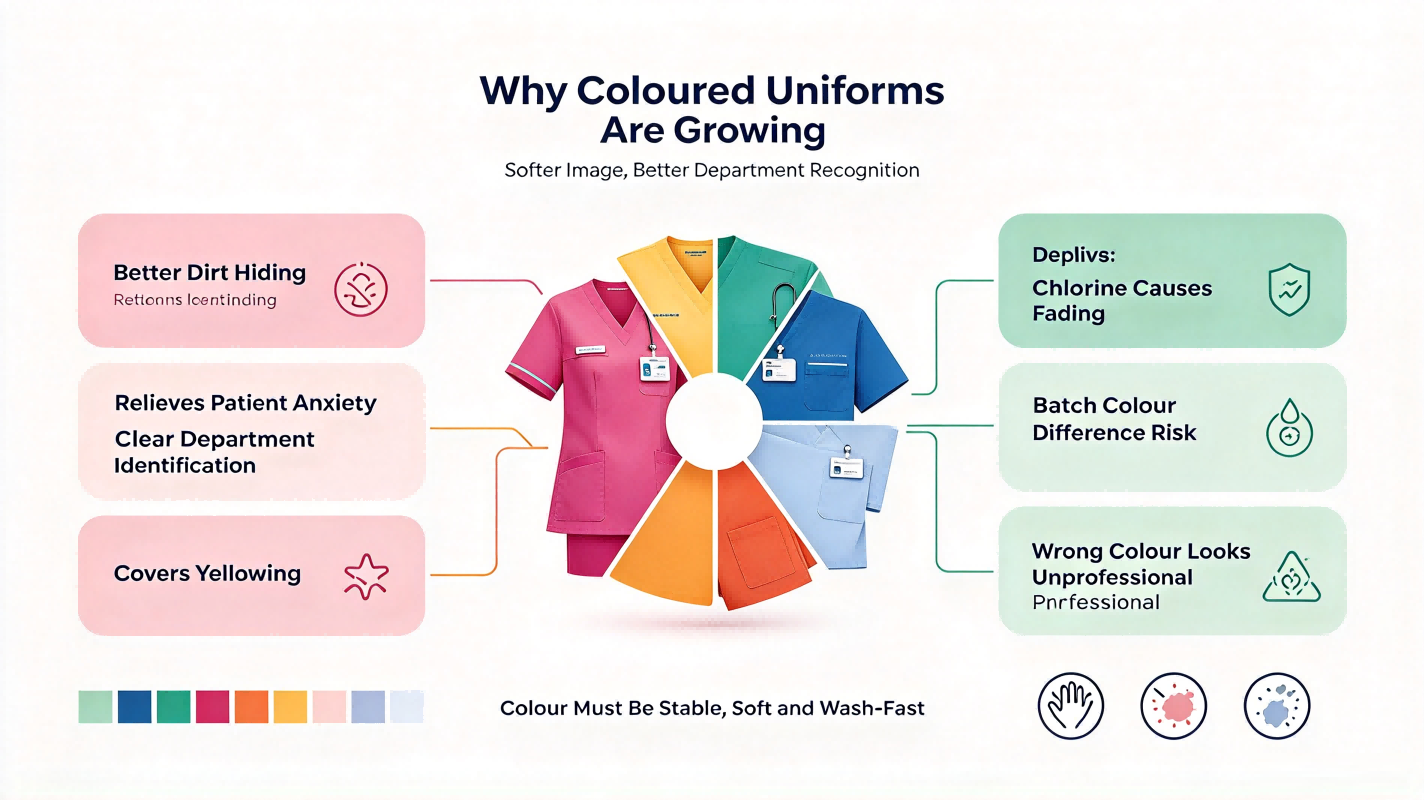
In recent years, more and more hospitals have started using coloured nurse uniforms, especially in paediatrics, obstetrics and gynaecology, psychiatry, and rehabilitation. There are several reasons:
First, dirt resistance. Light blue, light green, light pink – these colours are far more dirt-resistant than white. The same stain is less conspicuous on coloured fabric, so nurses don't have to worry constantly about "dirty clothes."
Second, relieving patient anxiety. White can sometimes feel cold in a hospital environment, especially for child patients. Coloured nurse uniforms are friendlier and warmer, helping to ease patient tension. Paediatric nurses in pink or light blue look less frightening to children, and cooperation is better.
Third, high departmental recognition. Different departments wearing different colours means patients and families can immediately recognise "this is a paediatrics nurse" or "this is an A&E nurse," making communication and navigation easier.
Fourth, covering the yellowing problem. Coloured nurse uniforms don't have a "yellowing" issue. They do fade, but fading is much easier to deal with than yellowing.
But coloured nurse uniforms also have downsides:
First, poor chlorine bleach resistance. Chlorine disinfectants destroy dyes. Coloured nurse uniforms fade and go blotchy after a few washes. This is the biggest challenge coloured nurse uniforms face in hospital laundries.
Second, difficult to guarantee colour consistency. Different batches of fabric may have colour differences. During bulk procurement, if the supplier changes dye vats or fabric batches, the colours won't match, and a batch of nurse uniforms will vary in shade – very unattractive.
Third, professional image may suffer. Choose the wrong colour – for example, overly bright fluorescent colours – and it looks unprofessional. Hospitals are serious places; nurse uniform colours should be stable and soft.
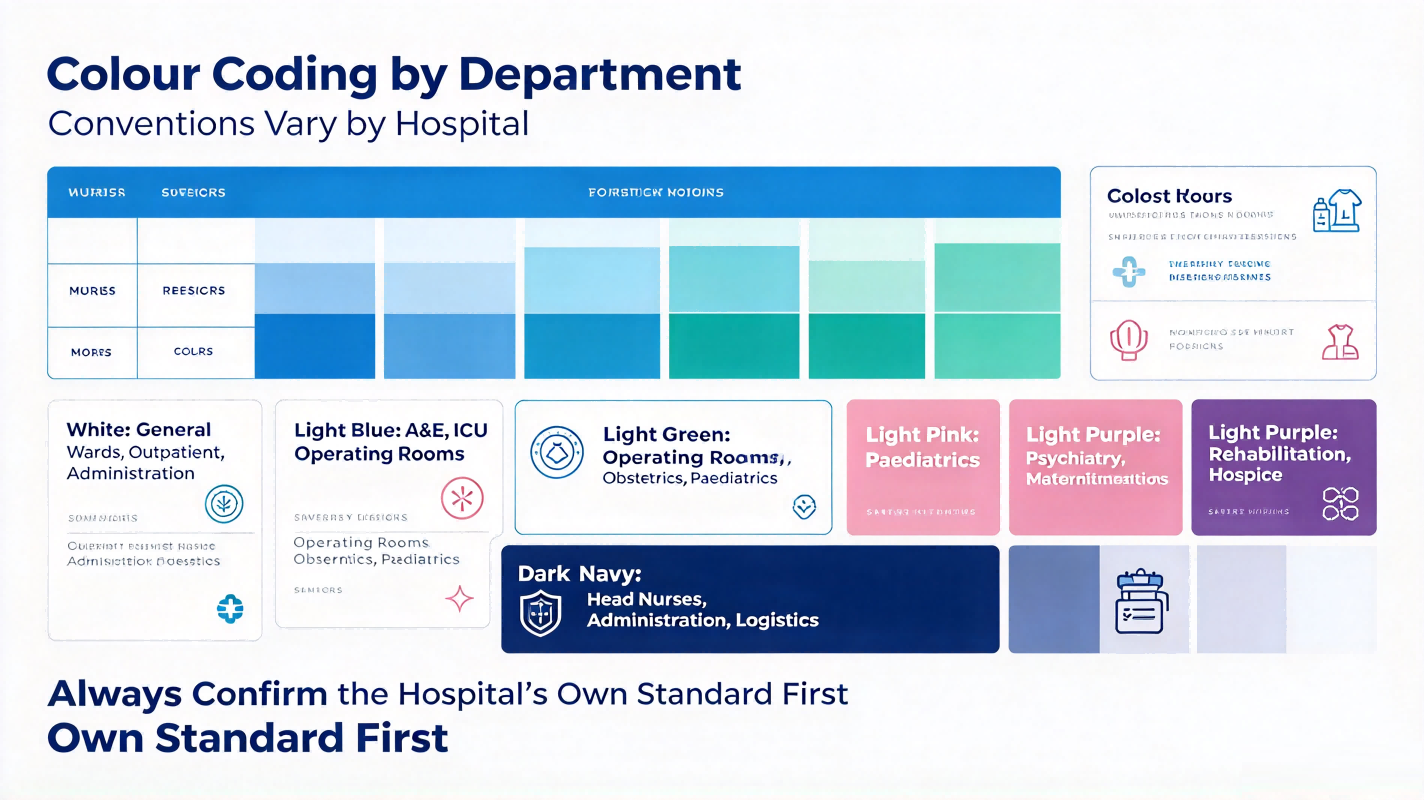
3. Colour coding for different departments: there are conventions, but no national uniform standard
There is no mandatory national standard for nurse uniform colour coding in China, but there is an established set of industry conventions. Different hospitals may vary, but the general direction is similar.
White – general, classic, the mainstay of wards and outpatient departments
White remains the main colour for nurse uniforms in most hospitals, especially general wards, outpatient departments, health check centres, and administrative roles. White represents cleanliness and professionalism and is the safest choice for hospitals.
Light blue – A&E, ICU, operating rooms
Light blue is often used in healthcare to identify A&E, ICU, operating rooms, and other acute and critical care departments. Blue conveys calm, professionalism, and trustworthiness – suitable for high-intensity, high-risk departments.
Light green – operating rooms, obstetrics and gynaecology, paediatrics
Light green is often used for operating room scrubs, obstetrics and gynaecology, and paediatrics. Green is easy on the eyes – in operating rooms, looking at green for long periods reduces visual fatigue. In paediatrics, light green is friendlier than white.
Light pink – paediatrics, maternal and infant wards, obstetrics and gynaecology
Pink is soft and warm, often used in paediatrics, maternal and infant wards, and obstetrics and gynaecology. For children and pregnant women, pink is friendlier than white and helps relieve tension.
Light purple – psychiatry, rehabilitation, special care
Purple conveys calm and soothing feelings. Some hospitals use it in psychiatry, rehabilitation, and hospice care – departments that need emotional reassurance.
Dark colours (navy, dark grey) – head nurses, administration, logistics
Dark nurse uniforms are often used for head nurses, nursing department administrators, and logistics support, distinguishing management from frontline nurses. Dark colours are more stable and dirt-resistant.
An important reminder: colour coding must follow the hospital's own regulations.
Different hospitals may have different colour systems. Some use red for A&E, others blue; some use pink for paediatrics, others yellow. Before procurement, always confirm with the nursing department: What is our hospital's colour coding standard? What colour corresponds to each department? Don't assume based on "industry convention."
4. Procurement points for coloured nurse uniforms: choose the right colour, and make sure it survives washing
The biggest challenge with coloured nurse uniforms isn't "what colour to choose" – it's "whether the colour can be maintained." The high temperature, chlorine disinfection, and strong washing in hospital laundries are an enormous test for the colour fastness of coloured fabrics.
When buying coloured nurse uniforms, focus on four indicators:
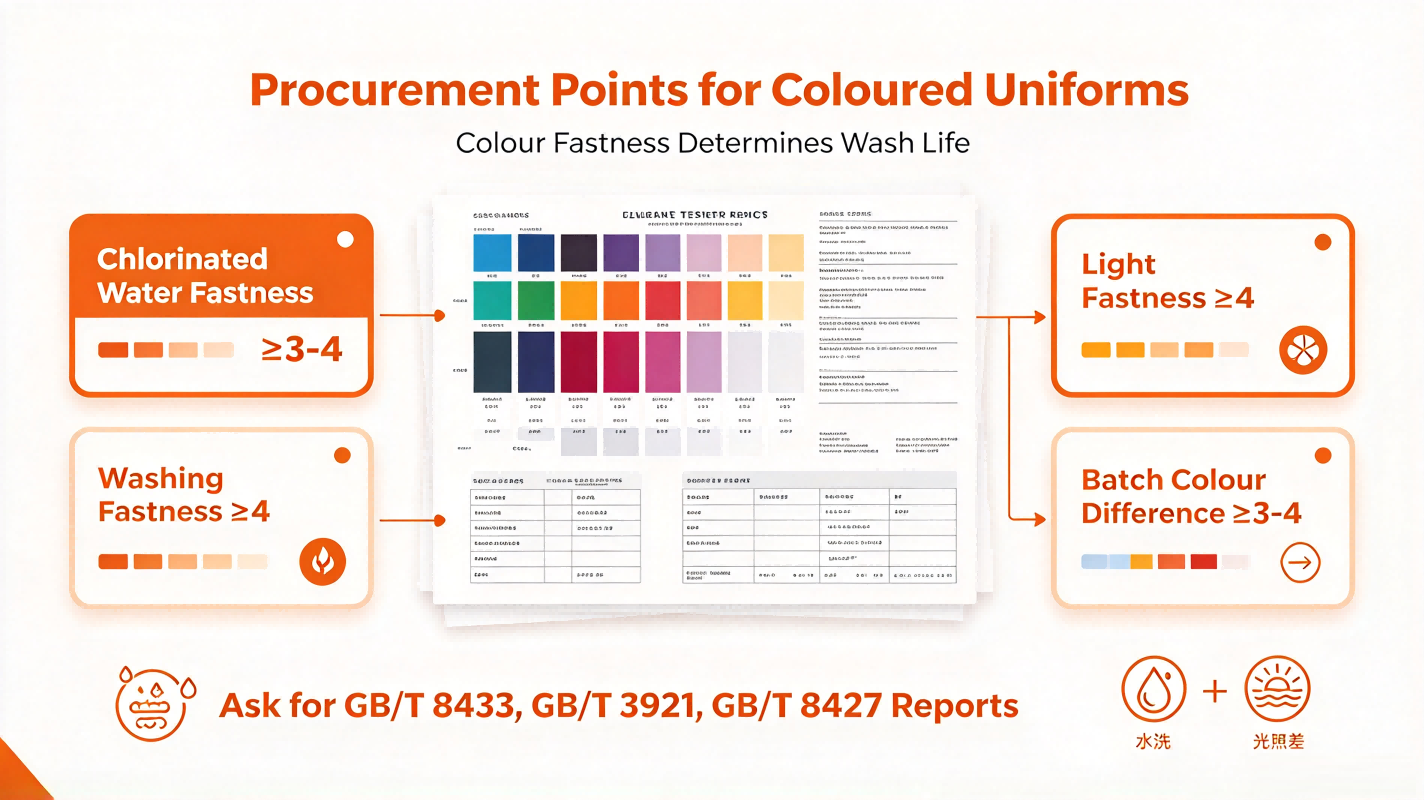
First, colour fastness to chlorinated water. Ask the supplier for a GB/T 8433 colour fastness to chlorinated water test report, with a grade no lower than 3-4. This is the core indicator determining whether coloured nurse uniforms can survive hospital laundries. Coloured fabric below this grade goes blotchy after a few washes.
Second, colour fastness to washing. According to GB/T 3921, colour fastness to soap washing should reach grade 4 or above. The smaller the colour change after 50 washes, the better.
Third, colour fastness to light. According to GB/T 8427, colour fastness to light should reach grade 4 or above. Nurse uniforms are often near windows and under lights; fabric with poor lightfastness fades easily.
Fourth, batch colour difference control. Ask the supplier for a colour difference test report. Colour difference within the same batch should be controlled to grade 3-4 or above on the GB/T 250 scale. For bulk procurement, it's best to stock enough fabric from the same batch at once to avoid colour mismatches on reorders.
What to ask during procurement?
Ask directly: "What grade is the colour fastness to chlorinated water? What grade is the colour fastness to washing? What grade is the colour fastness to light? What grade is the batch colour difference controlled to?" A supplier who can give specific grades is a supplier who has genuinely handled hospital orders.
5. Procurement points for white nurse uniforms: anti-yellowing, anti-see-through, chlorine bleach resistance
Although white nurse uniforms are classic, procurement is no easier than for coloured ones. White is most sensitive to yellowing, light transmission, and staining.
When buying white nurse uniforms, focus on four indicators:
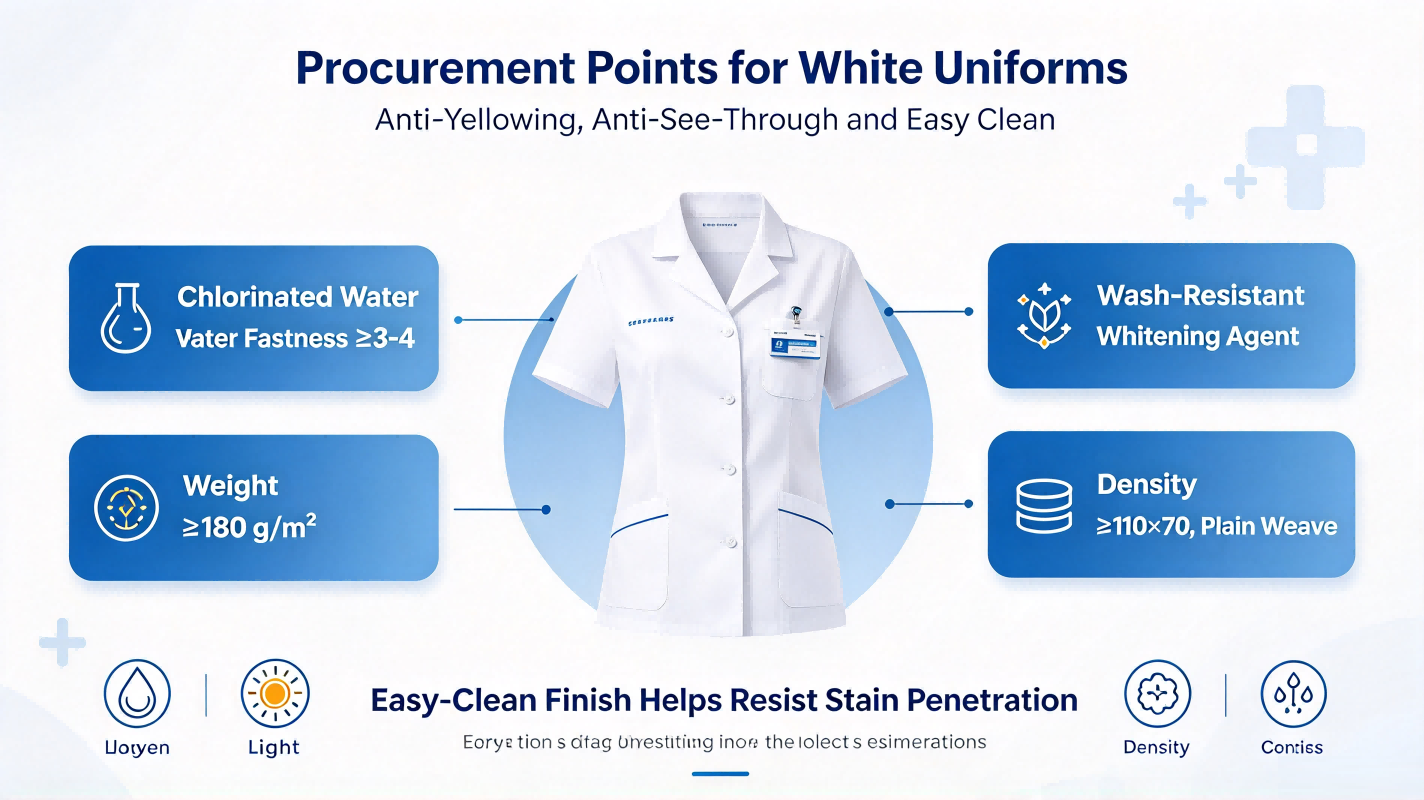
First, colour fastness to chlorinated water (anti-yellowing). Also require GB/T 8433 colour fastness to chlorinated water of no less than 3-4. White fabric with poor chlorine bleach resistance yellows after a few washes—and it's irreversible.
Second, wash resistance of the fluorescent whitening agent. Ask clearly whether the fabric contains a fluorescent whitening agent and whether it's wash-resistant. A whitening agent with poor wash resistance washes out after a dozen or so washes, and the garment visibly dulls.
Third, density and weight (anti-see-through). White nurse uniforms should preferably weigh no less than 180 g/m², with a density no less than 110×70, and plain weave is preferred. White nurse uniforms that are too thin or too loosely woven are visibly translucent and awkward to wear.
Fourth, easy-clean finish. Ask whether the fabric has an easy-clean finish. White nurse uniforms with an easy-clean finish resist stains penetrating the fibres and are easier to clean during washing.
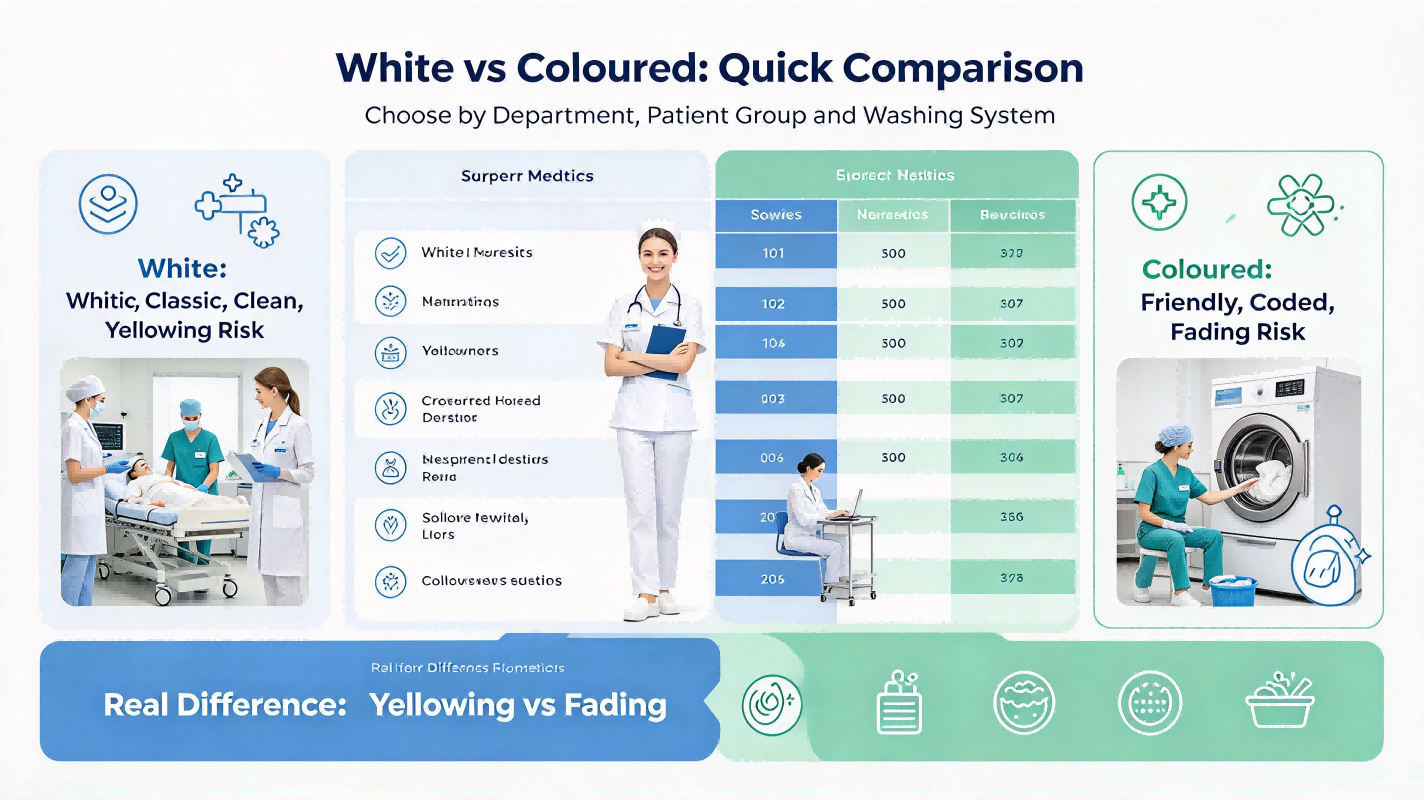
6. How to choose between white and colour? A quick table
|
Comparison |
White nurse uniforms |
Coloured nurse uniforms |
|
Professional image |
Strong, classic |
Depends on colour; can be professional if chosen well |
|
Dirt resistance |
Poor – stains obvious |
Better – stains less conspicuous |
|
Yellowing |
Prominent, irreversible |
Not applicable |
|
Fading |
Not applicable |
Exists – depends on colour fastness |
|
Chlorine bleach requirement |
High (anti-yellowing) |
High (anti-fading) |
|
Patient perception |
Clean, but may feel cold |
Friendly, relieves tension |
|
Departmental identification |
General |
High recognition |
|
Washing difficulty |
Medium (anti-yellowing) |
High (anti-fading, anti-colour difference) |
|
Suitable departments |
Wards, outpatient, administration |
Paediatrics, obstetrics and gynaecology, A&E, ICU, psychiatry |
7. Five questions you must ask during procurement
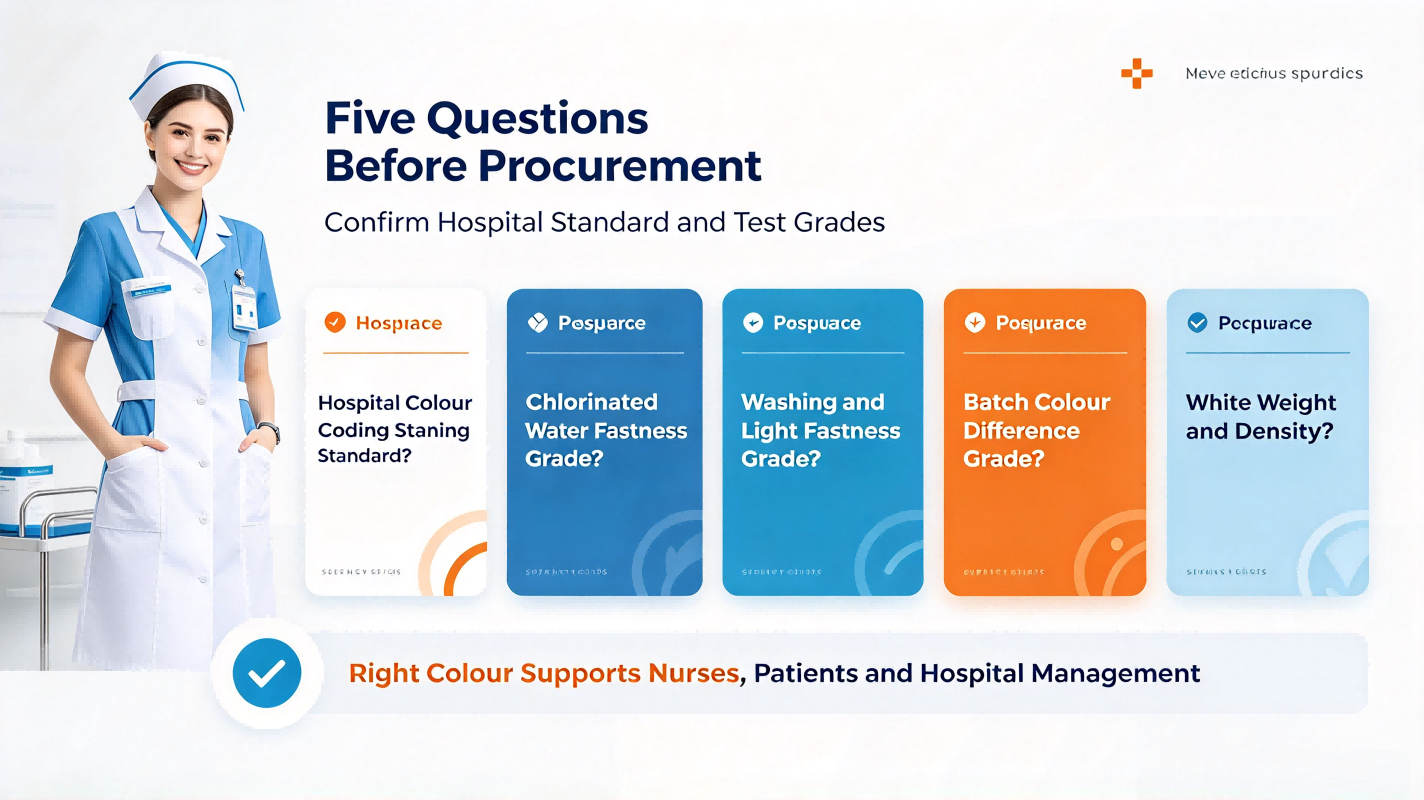
First, what is the hospital's colour coding standard? Confirm with the nursing department which colour corresponds to each department first – don't assume based on industry convention.
Second, what grade is the colour fastness to chlorinated water? Ask for both white and coloured – white for anti-yellowing, coloured for anti-fading. No lower than grade 3-4.
Third, what grades are the colour fastness to washing and to light? Focus on coloured nurse uniforms – no lower than grade 4.
Fourth, what grade is the batch colour difference controlled to? For bulk procurement of coloured nurse uniforms, poor colour difference control means a batch of garments in varying shades.
Fifth, what are the weight and density of the white version? Focus on white nurse uniforms – weight no less than 180 g/m², density no less than 110×70.
8. A common misconception: "Coloured is more durable than white"
Many buyers think coloured nurse uniforms are more durable than white. That's not entirely true.
Coloured nurse uniforms' "durability" lies in dirt resistance – stains are less obvious. But coloured nurse uniforms face fading – chlorine bleaching makes them go blotchy after a few washes, and their lifespan isn't necessarily longer than white.
White nurse uniforms' "lack of durability" lies in yellowing – they dull after repeated washing. But if you choose white fabric that is chlorine-bleach resistant and has a wash-resistant whitening agent, the lifespan can also be long.
The real difference isn't "which is more durable" – it's "whose problem is easier to solve." White's problem is yellowing, alleviated by chlorine-bleach-resistant fabric and correct care. Colour's problem is fading, alleviated by high-colour-fastness fabric and avoiding chlorine bleaching.
A final honest word
Whether to choose white or coloured nurse uniforms has no single right answer. It depends on department needs, hospital regulations, and patient groups.
General wards, outpatient departments, administrative roles – white is the safe choice: classic, professional, uniform.
Paediatrics, obstetrics and gynaecology, maternal and infant wards – colour is more suitable; pink and light green help relieve patient tension.
A&E, ICU, operating rooms – light blue is the industry convention: calm and professional.
Psychiatry, rehabilitation – soft colours like light purple help soothe emotions.
Head nurses, administrative staff – dark colours distinguish management, stable and dirt-resistant.
During procurement, don't just ask "How much per piece?" Ask first: "What is our hospital's colour coding standard? What grade is the colour fastness to chlorinated water? What grade is the batch colour difference controlled to?" – A supplier who can answer these questions clearly is a supplier who has genuinely handled hospital orders.
Nurse uniform colour isn't just a question of looking good or not. It relates to departmental identification, patient perception, nurse psychology, and washing lifespan. Choose the right colour, and nurses stay comfortable while hospital management has one less thing to worry about.