What Are You Looking For?


Anyone who buys nurse uniforms has probably agonised over this question at some point—100% cotton or poly-cotton?
Ask the nurses, and they say, "Cotton is comfortable and absorbs sweat." Ask the laundry department, and they say, "Cotton loses its shape after a few washes, and it can't handle chlorine bleach." Ask the supplier, and they say, "It depends on your needs." After asking everyone, you're still no closer to a decision.
So where's the problem? Nurse uniforms aren't ordinary workwear – their use scenarios are more complex than most workwear. They're worn 8 to 12 hours a day, washed two or three times a week, and subjected to high-temperature disinfection and chlorine bleaching. Nurses in different departments have completely different work intensity, sweat output, and contamination risks. You can't choose fabric with a one-size-fits-all approach—you have to look at the department, the washing conditions, and the actual wearing requirements.
Today, we're going to break down the pros and cons of 100% cotton and poly-cotton in the nurse uniforms, then give material selection recommendations by department.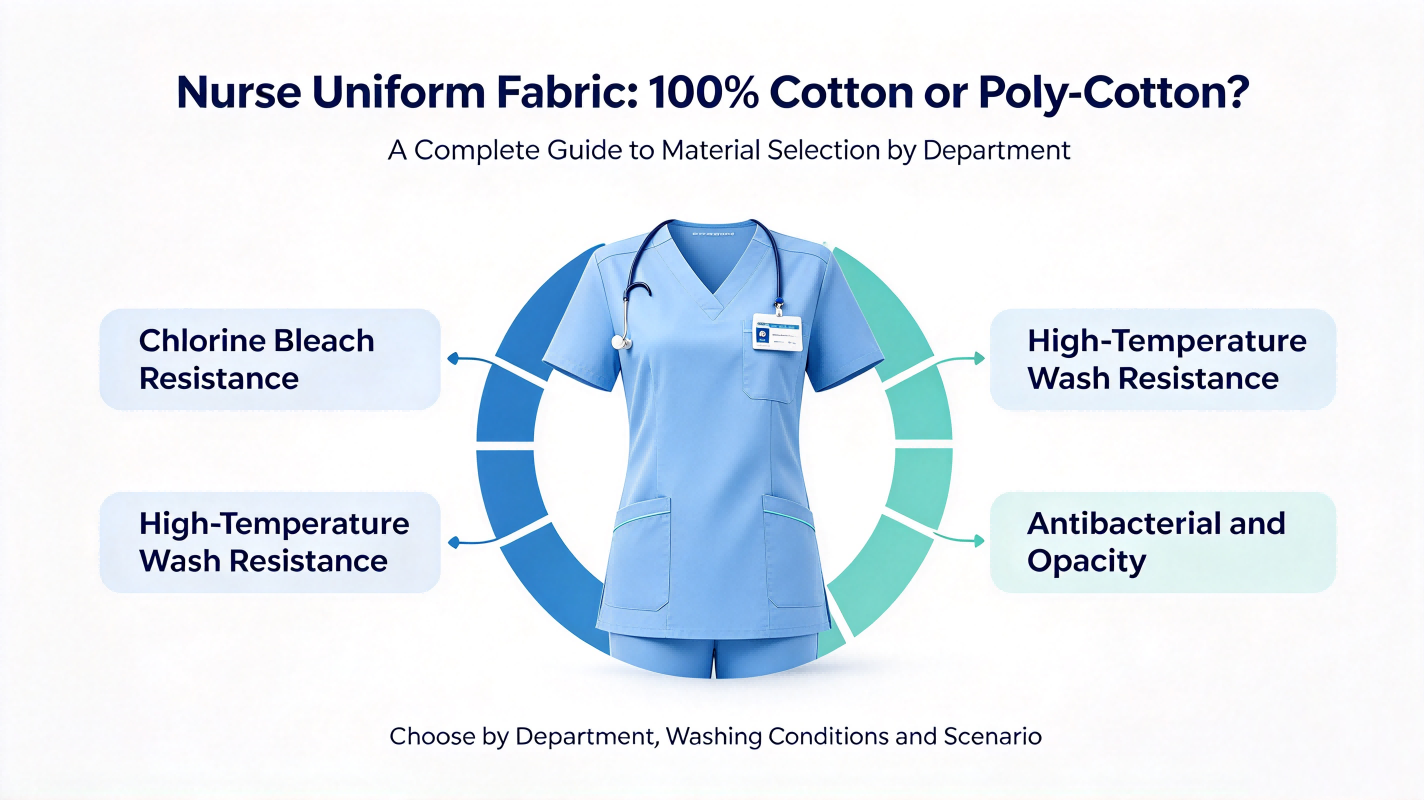
1. First, let's get clear: what makes nurse uniforms different from ordinary workwear?
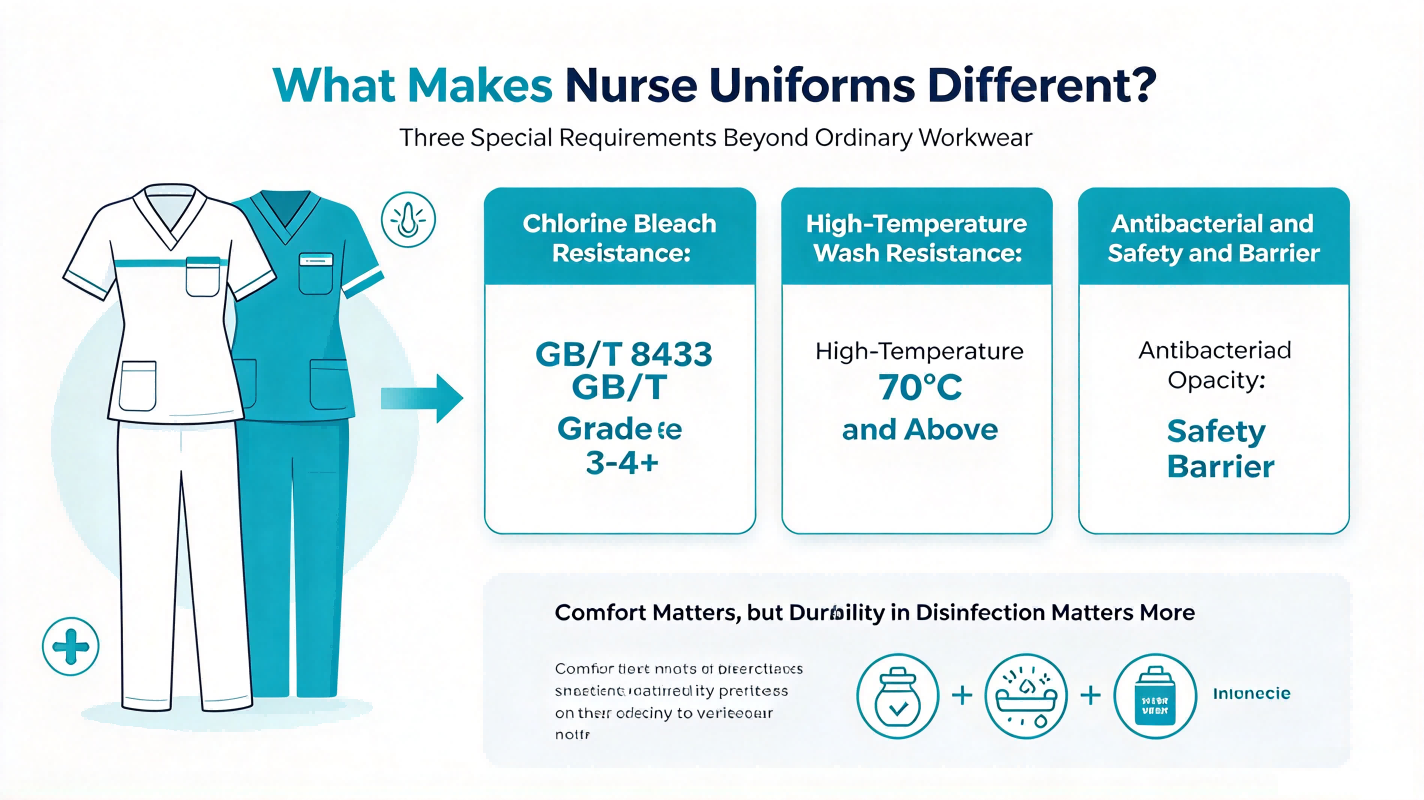
The core requirements for ordinary workwear are durability, abrasion resistance, and easy washing. Nurse uniforms have three additional special requirements:
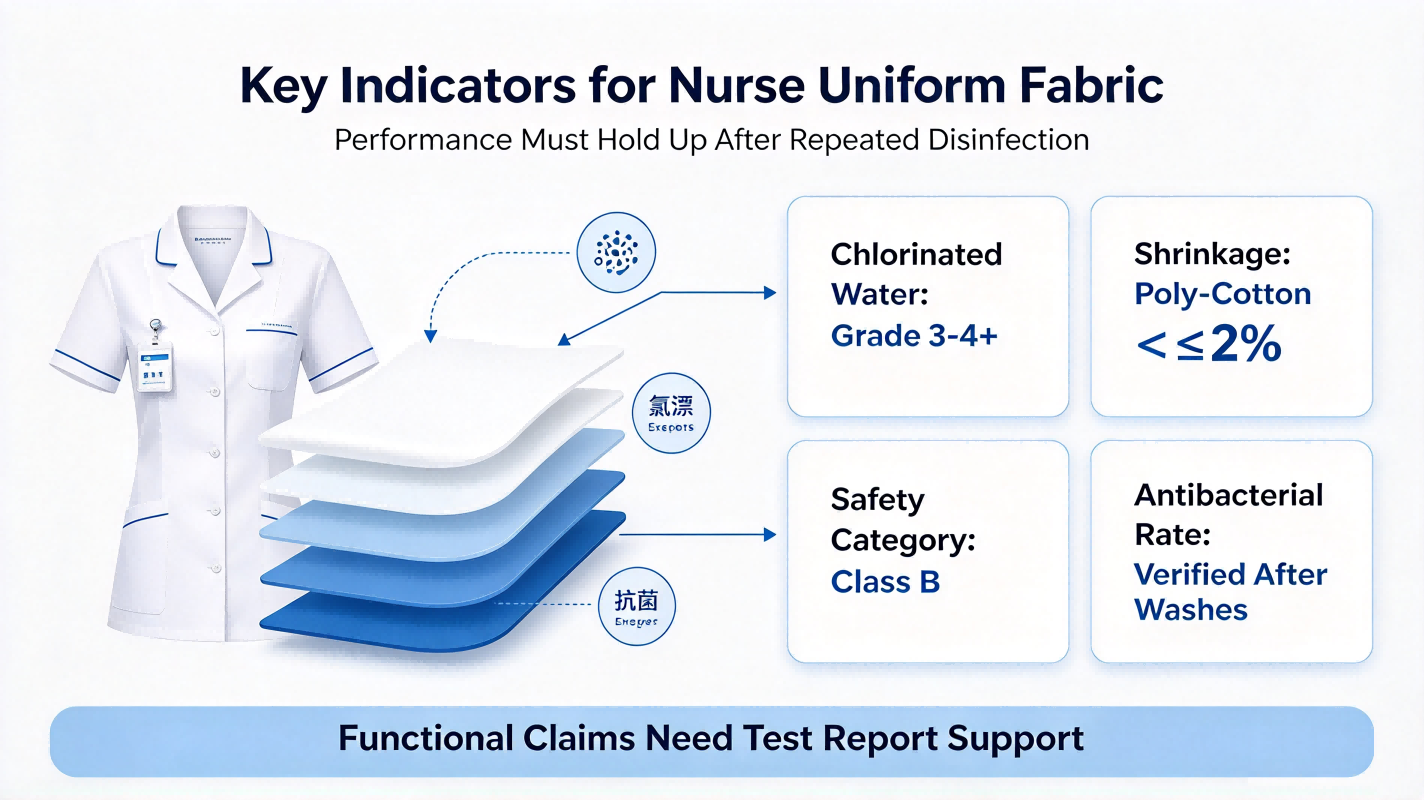
First, chlorine bleach resistance. Hospital laundries commonly use chlorine-based disinfectants (sodium hypochlorite) for disinfecting washes. Chlorine bleach damages cotton fibres significantly—ordinary 100% cotton nurse uniforms become brittle and develop holes after a few dozen washes. Nurse uniform fabric must be resistant to chlorine bleach, and colour fastness must also hold up. According to GB/T 8433 colour fastness to chlorinated water standards, nurse uniforms generally need to reach grade 3-4 or above.
Second, high-temperature washing resistance. Medical textile washing and disinfection usually require washing at 70℃ or above, and in some scenarios even 90℃. Repeated high-temperature washing accelerates shrinkage and fibre damage in 100% cotton, while poly-cotton has better dimensional stability.
Third, antibacterial and opacity. Nurse uniforms come into direct contact with patients, so the fabric needs some antibacterial performance to reduce cross-infection risk. At the same time, nurse uniform fabric shouldn't be too sheer—especially white and light-coloured uniforms, which need sufficient density and opacity finishing.
These special requirements mean that choosing nurse uniform fabric can't just be about "comfort when wearing."
2. 100% cotton: comfortable, yes – but its weaknesses are more pronounced in nurse uniforms
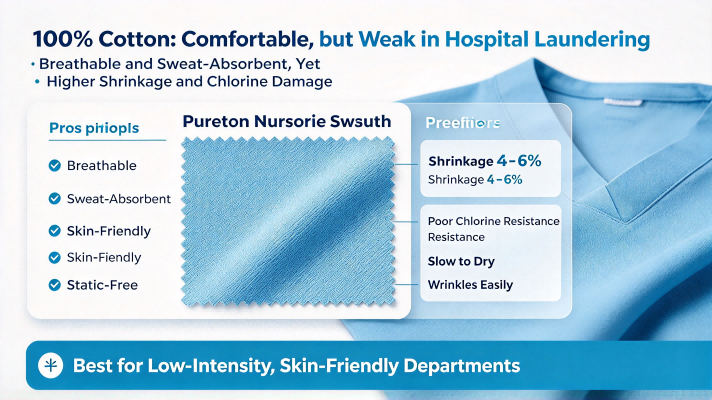
Everyone knows the advantages of 100% cotton – breathable, sweat-absorbing, skin-friendly, and static-free. Nurses wearing cotton uniforms do feel comfortable, especially in summer when they sweat a lot – cotton fibres pull sweat away so it doesn't cling to the skin.
But in the nurse uniform context, cotton's weaknesses are more prominent than in ordinary workwear:
First, high shrinkage. 100% cotton shrinks 4% to 6% after standard washing. Nurse uniforms are washed two or three times a week – after a month, a perfectly fitting uniform can be noticeably shorter. Bulk orders end up with chaotic sizing, and reorders become a nightmare.
Second, poor chlorine bleach resistance. This is the most critical point. Chlorine disinfectants oxidise cotton fibres, reducing fibre strength. 100% cotton nurse uniforms develop holes and become brittle after a few dozen washes under chlorine bleaching. Many hospital laundries report that cotton nurse uniforms typically last only about half as long as poly-cotton ones.
Third, slow to dry. Cotton absorbs sweat well but dries slowly. After a shift, a nurse's uniform can be soaked through. If it needs to be worn again the next day, cotton might not dry overnight. During the rainy season, it's even worse.
Fourth, it wrinkles easily. After a day's wear, cotton nurse uniforms show obvious wrinkles. Hospitals have image standards for nurses, and wrinkled uniforms affect professional appearance.
Which departments is 100% cotton suitable for?
Paediatrics, maternal and infant wards, psychiatry – these departments have high requirements for skin-friendliness and softness, and patients and families are more sensitive to how a nurse's uniform feels. You can choose high-cotton CVC or combed pure cotton, but you need to accept a higher replacement frequency.
Outpatient clinics, health check centres – work intensity is relatively low, sweating is minimal, and cotton's comfort advantage is more obvious. But you still need to watch out for shrinkage and chlorine bleach issues.
3. Poly-cotton: the mainstream choice for nurse uniforms, but the blend ratio determines performance
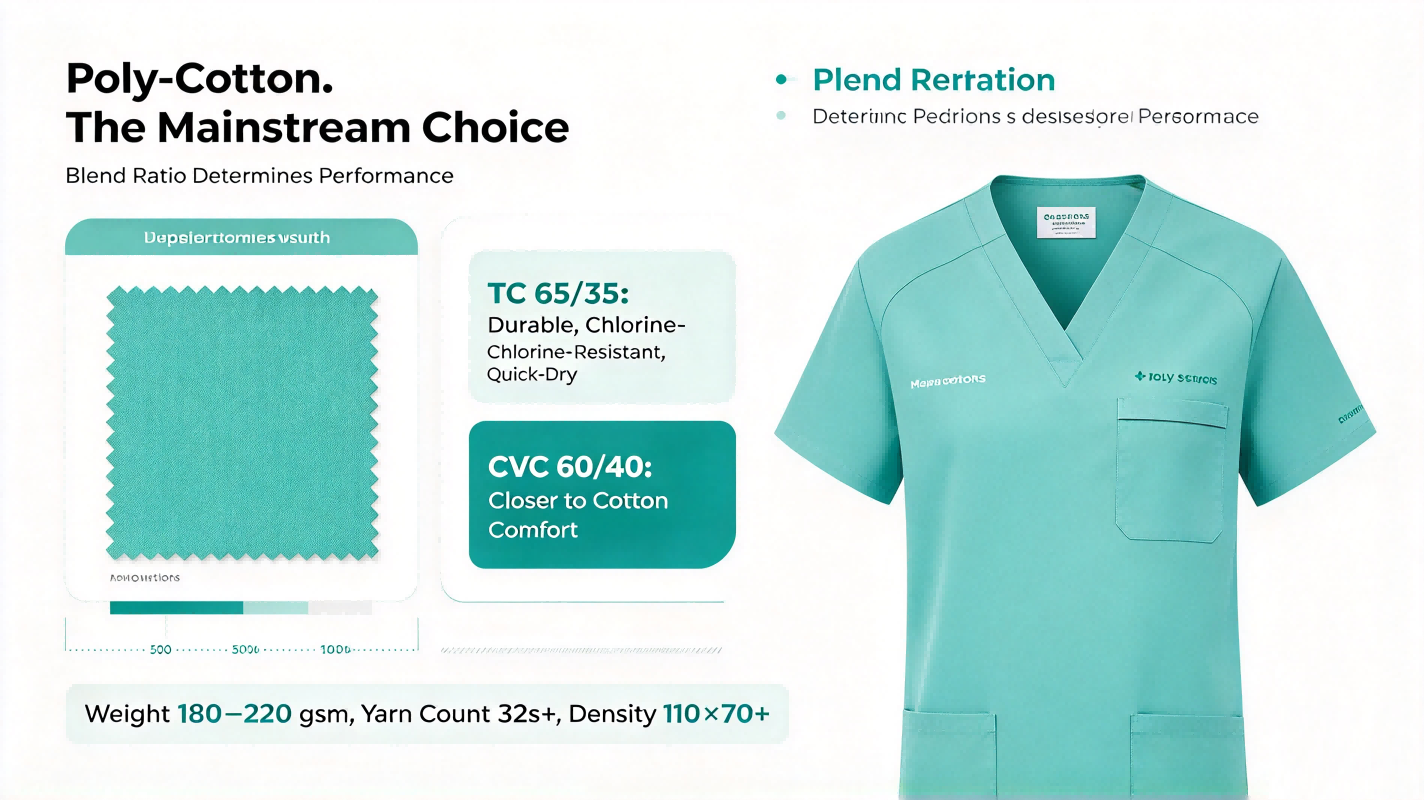
Poly-cotton is currently the most widely used fabric for nurse uniforms. The common ratios are 65% polyester + 35% cotton (TC) and 60% cotton + 40% polyester (CVC).
Poly-cotton's advantages in the nurse uniform context are very real:
First, chlorine bleach resistance. Polyester fibres are far more resistant to chlorine disinfectants than cotton fibres. Poly-cotton nurse uniforms last much longer under chlorine bleaching. This is the fundamental reason hospital laundries prefer poly-cotton.
Second, wrinkle resistance and low shrinkage. Poly-cotton shrinks only about 2%, and barely wrinkles after washing—nurses look crisp and professional. Nurse uniforms need to maintain a neat appearance, and this matters.
Third, it dries fast. Polyester doesn't absorb water, so poly-cotton nurse uniforms dry quickly after washing—ideal for departments that need frequent changes.
Fourth, durable and abrasion-resistant. Poly-cotton's abrasion resistance is about 40% higher than pure cotton—suitable for high-intensity departments.
Poly-cotton's downsides are also obvious:
First, it is less breathable than cotton. The higher the polyester ratio, the less breathable. In summer, when sweating heavily, nurses wearing high-polyester uniforms feel stuffy.
Second, they are prone to static. Polyester is synthetic and generates static in dry environments. In operating rooms, ICUs, and other departments with precision instruments, static can interfere with equipment.
Third, low-quality poly-cotton pills easily. If the supplier uses low-quality poly-cotton, it develops fuzz balls with wear, affecting appearance.
How to choose between TC and CVC?
- TC (65/35): Polyester-dominant – abrasion-resistant, wrinkle-resistant, quick-drying, and chlorine-bleach resistant. Suitable for ICU, emergency, operating rooms, infectious diseases departments – high washing frequency and high durability requirements.
- CVC (60/40): Cotton-dominant – comfort close to pure cotton, while retaining poly-cotton durability. Suitable for wards, outpatient clinics, paediatrics – departments with higher comfort requirements.
Procurement note: Even within poly-cotton, different weights, yarn counts, and densities make a big difference. Common nurse uniform weights range from 180–220 gsm; choose lighter versions for summer and slightly heavier for spring/autumn. Yarn count should be at least 32s, and density at least 110×70.
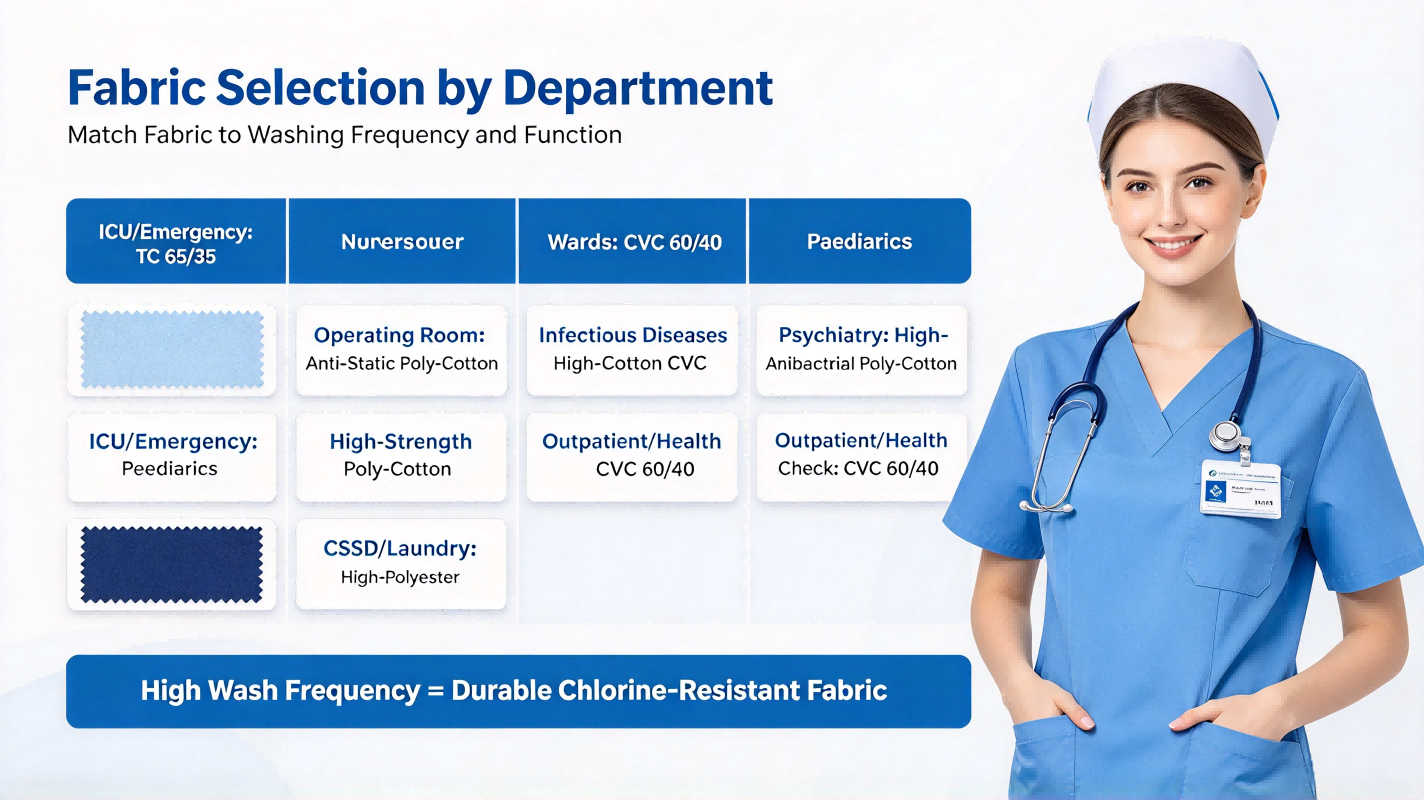
4. How to choose for different departments? A quick table
|
Department |
Core needs |
Recommended fabric |
Reason |
|
ICU/Emergency |
Chlorine bleach resistance, quick-dry, durable |
TC 65/35 or stretch poly-cotton |
High washing frequency, heavy sweating, needs quick-dry and durability |
|
Operating room |
Anti-static, high-temp resistant, fluid-repellent |
Special surgical gown fabric (poly-cotton + anti-static) |
Requires anti-static and fluid-repellent functions, complies with YY/T 0506 |
|
Wards |
Comfortable, durable, chlorine-bleach resistant |
CVC 60/40 |
Balances comfort and durability |
|
Paediatrics |
Soft, skin-friendly, safe |
High-cotton CVC or combed pure cotton |
Patients have sensitive skin, need softness and skin-friendliness |
|
Infectious diseases |
Antibacterial, chlorine-bleach resistant, barrier |
Poly-cotton + antibacterial finish |
Requires antibacterial and chlorine-bleach resistance to prevent cross-infection |
|
Psychiatry |
Tear-resistant, abrasion-resistant |
High-strength poly-cotton (thicker) |
Patients may tear at clothing, needs high-strength fabric |
|
Outpatient/Health check |
Comfortable, crisp, good image |
CVC 60/40 |
Low work intensity, prioritises image and comfort |
|
CSSD/Laundry |
High-temp resistant, chlorine-bleach resistant |
High-polyester poly-cotton |
Exposed to disinfection and washing, needs extreme chlorine-bleach resistance |
5. Five questions you must ask during procurement
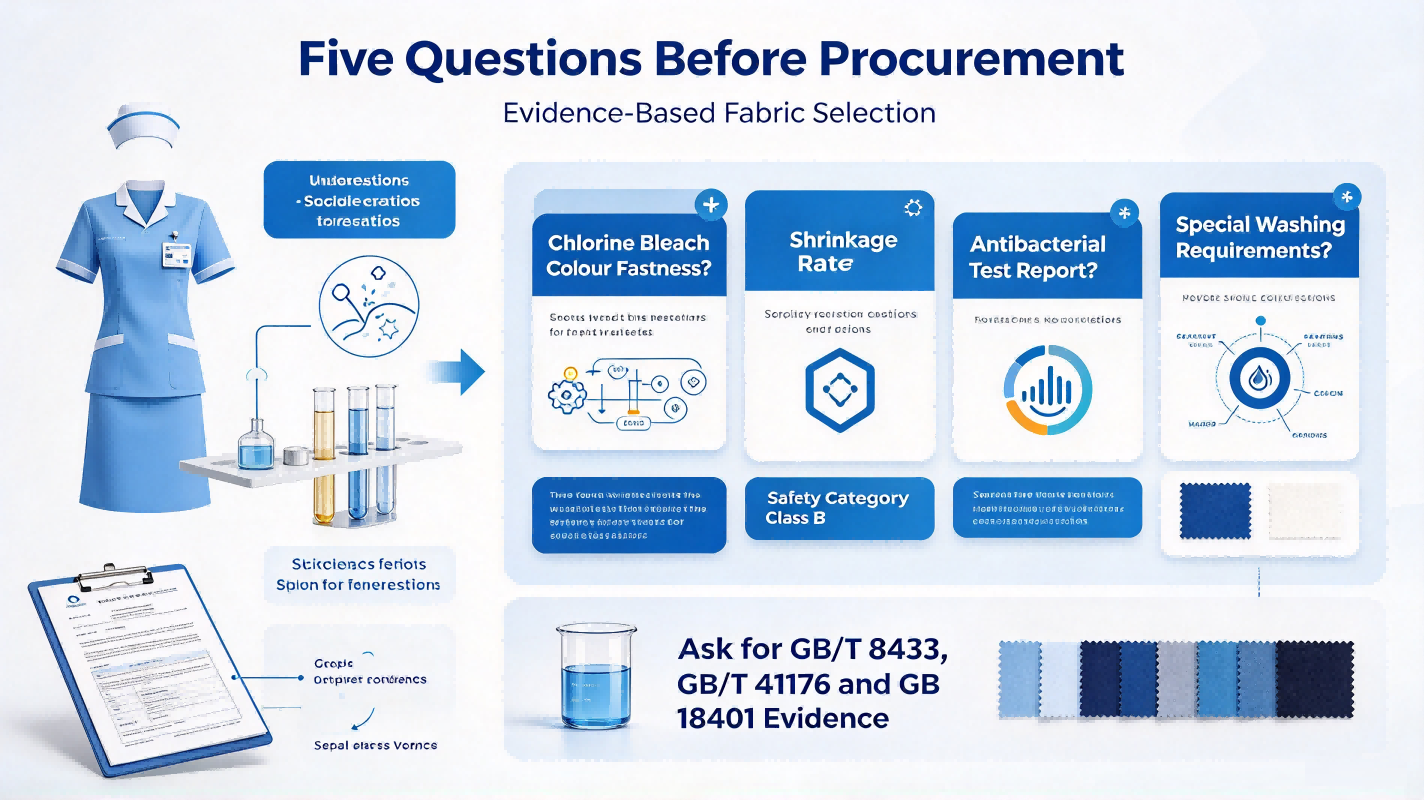
First, what's the chlorine bleach colorfastness? Ask the supplier for a GB/T 8433 colour fastness to chlorinated water test report, with a grade no lower than 3-4. This is the core indicator that distinguishes nurse uniforms from ordinary workwear.
Second, what's the shrinkage rate? Ask for a dimensional change after washing report according to GB/T 41176-2021 or relevant standards. Poly-cotton should be within 2%, and pure cotton within 5%.
Third, is the safety category Class B or Class C? Nurse uniforms come into direct contact with skin, so they must meet GB 18401-2010 Class B requirements. Formaldehyde ≤ 75 mg/kg, pH 4.0–8.5.
Fourth, is there an antibacterial test report? If the supplier claims antibacterial function, ask for a GB/T 20944 or FZ/T 73023 test report, specifying the antibacterial rate after washing cycles.
Fifth, are there special washing requirements? Nurse uniforms need high-temperature chlorine bleach washing, so the supplier must confirm the fabric can withstand these conditions. If the supplier says "no chlorine bleach," then that fabric isn't suitable for nurse uniforms.
A final honest word
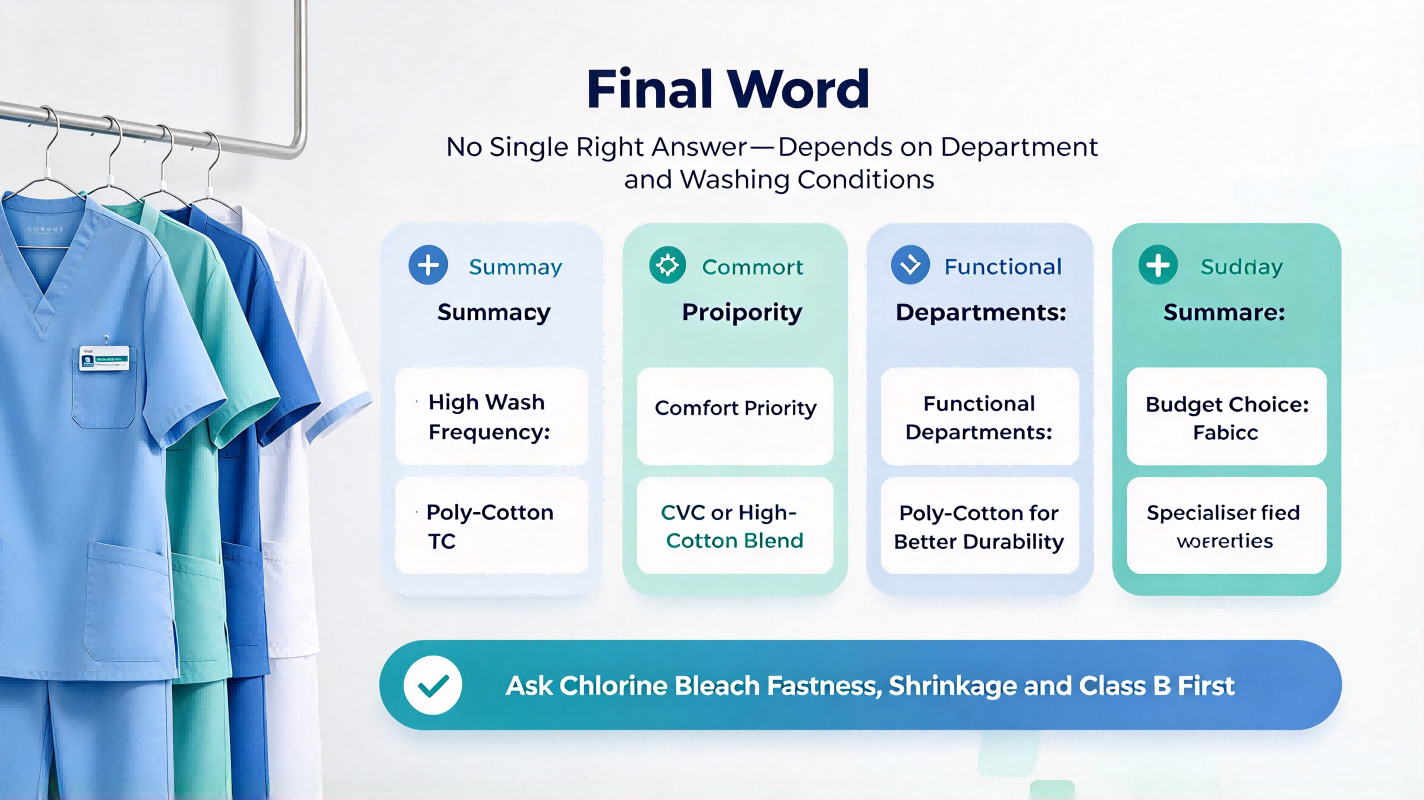
Whether to choose 100% cotton or poly-cotton for nurse uniforms has no single right answer. It depends on department needs, washing conditions, and wearing scenarios.
For departments with high washing frequency and chlorine disinfection, choose poly-cotton TC—durable, chlorine-bleach resistant, quick-drying.
For departments prioritising comfort and skin-friendliness—choose CVC or high-cotton blends—balancing comfort and durability.
For operating rooms, ICUs, and other departments with functional requirements – choose specialised functional fabrics – anti-static, fluid-repellent, high-temperature resistant.
For departments with limited budgets – poly-cotton is cheaper than pure cotton, and for the same budget you can get better workmanship and more durable garments.
When buying, don't just ask "How much?" Ask first: "What's the chlorine bleach colour fastness? What's the shrinkage rate? Do you have a Class B test report?" – being able to ask those questions tells the supplier you know what you're doing, and their quotes will be much more realistic.
Nurse uniforms are the battle gear that nurses wear every day, wash every week, and put through disinfection. Choose the right fabric, and nurses stay comfortable, hospitals save on repeated purchases, and laundries have far fewer headaches.