What Are You Looking For?

When buying nurse uniforms, the dense numbers on the size chart are the most headache-inducing part. Height, weight, chest circumference, garment length, sleeve length, trouser length—every manufacturer arranges them differently. Some use S/M/L, others use 155/160/165. You stare at it for ages and still don't know which size to choose.
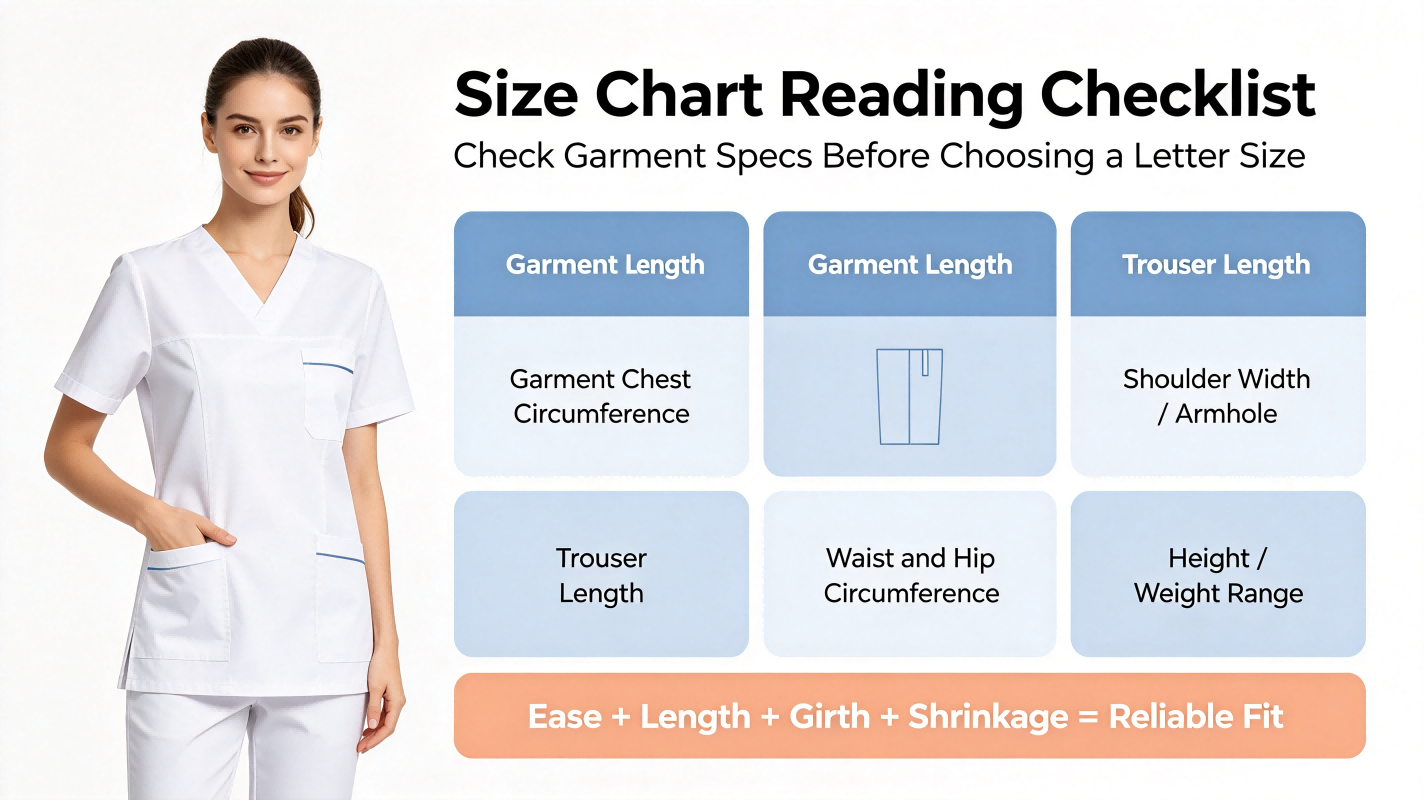
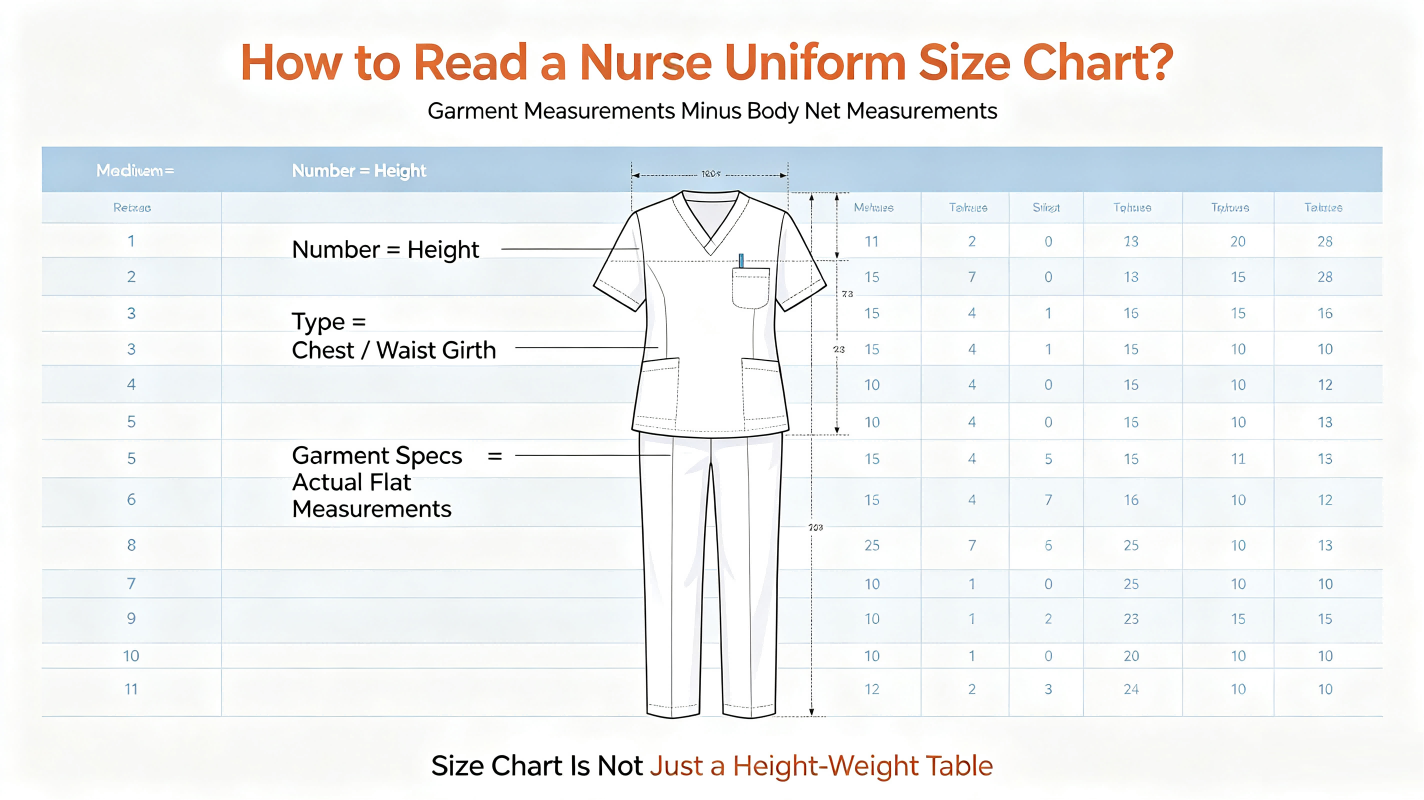
So where's the problem? Many people treat the size chart as a "height-weight look-up table," but what the size chart is really telling you is the difference between "garment measurements" and "body net measurements." Understanding that difference is more useful than memorising any chart.
Today, we're going to break down the nurse uniform size chart—from the sizing basis to the conversion logic for garment and trouser length, and then the most common pitfalls in procurement and wearing.
2. How to convert for tops: chest circumference looks at the "difference," garment length looks at "whether it covers"
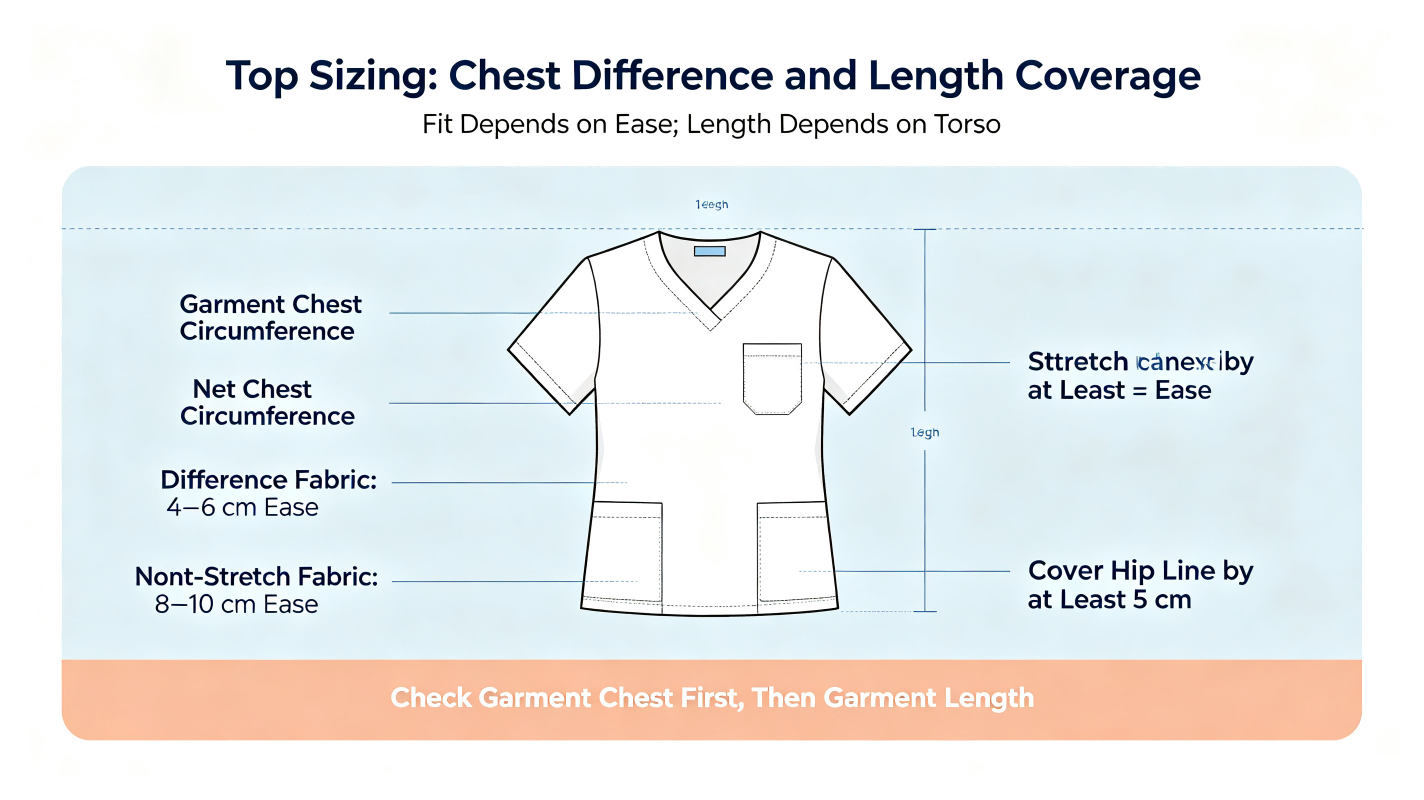
Chest circumference: don't look at the absolute value of the garment's chest circumference—look at its difference from your net chest circumference.
A nurse uniform labelled 165/L might have a garment chest circumference of 104 cm. If your net chest circumference is 88 cm, the difference is 16 cm—plenty of ease for movement. But if your net chest circumference is 96 cm, the difference is only 8 cm, and on non-stretch fabric, bending and raising your arms will feel noticeably tight.
There is a fairly common ease logic in the industry: for stretch fabric containing ≥5% spandex, the garment chest circumference only needs to be 4–6 cm larger than the net chest circumference to meet basic movement needs; for non-stretch or low-stretch woven fabric (pure cotton, ordinary poly-cotton), it needs to be 8–10 cm larger. Some Japanese nurse uniform brands give more specific reference ease: chest circumference +6–8 cm, shoulder width +3–5 cm, waist circumference +2–4 cm, hip circumference +3–5 cm.
When reading the size chart, go directly to the "garment chest circumference" column and subtract your net chest circumference. If the difference falls within the range above, the chest circumference is suitable.
Garment length: look at "whether it covers," not at the number itself.
Whether the garment length is 68 cm or 72 cm means nothing on its own. It has to match your height and torso length. A common reference is: standard garment length should cover the hip line by at least 5 cm. If the garment length is noticeably shorter than this, the lower back may be exposed when bending; if it's too long, it can make you look shorter and affect movement.
Take a common nurse uniform size chart as an example: 155/S garment length 68 cm, 165/L garment length 72 cm, 175/2XL garment length 76 cm. A 4 cm difference in garment length roughly corresponds to a 5 cm height grade difference. If your torso is longer or shorter than average and you fall between two grades, the garment length may be too short or too long – this is the fundamental reason why "after choosing the right size by chest circumference, the garment length may still be unsuitable," and why tops and trousers sometimes need to be sized separately.
Shoulder width and armhole: the "hidden indicators" easily overlooked on size charts.
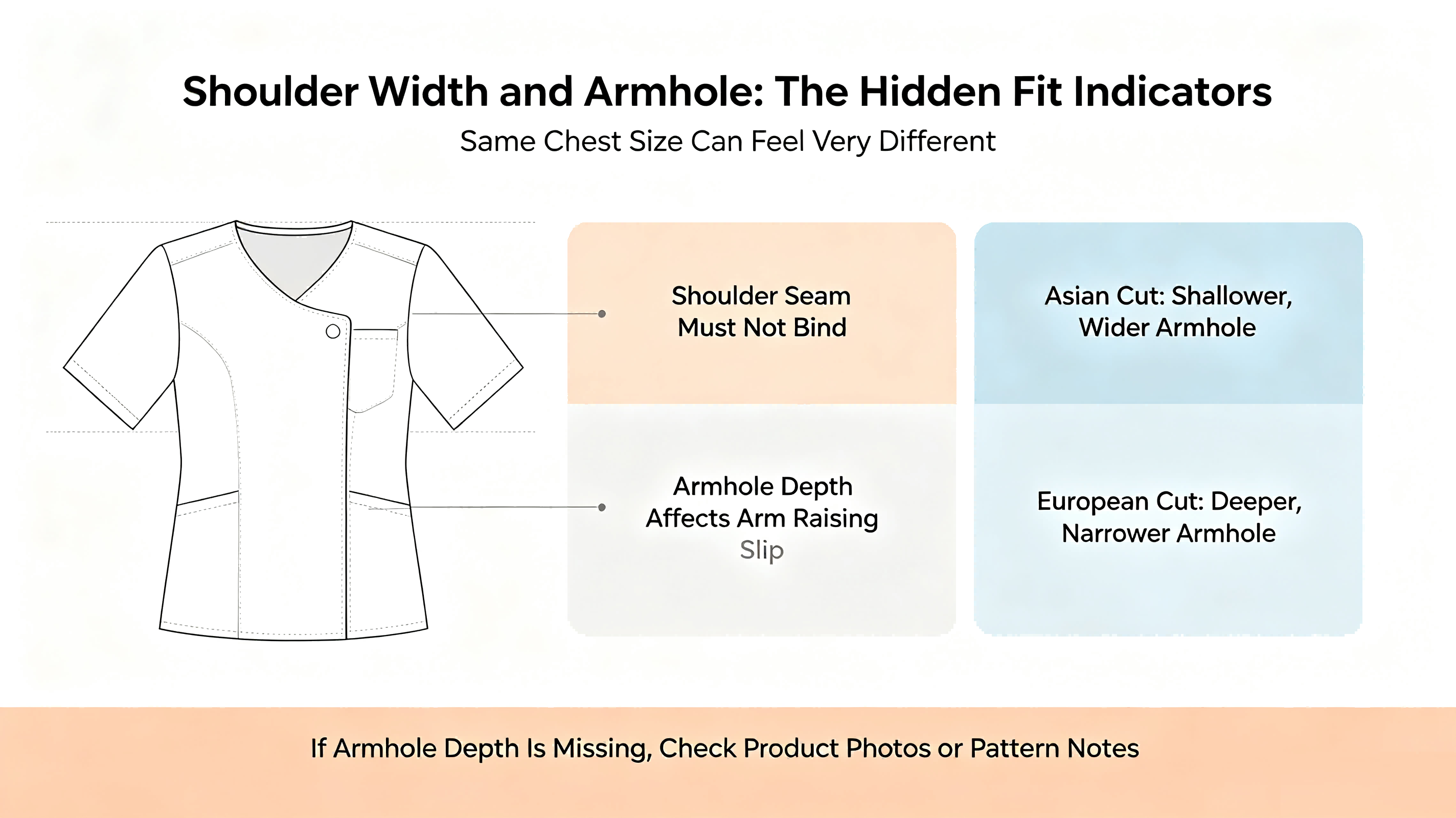
Shoulder width data is usually on the size chart, but many people don't look at it. If shoulders are narrow and you size up, the armholes slip down; if shoulders are broad and you size down, the shoulder seams bind and arm-raising is restricted.
Even more hidden than shoulder width is armhole depth. With the same suitable chest circumference, if the armhole is shallow and narrow, raising your arms will pull the whole garment upward and create obvious tension under the armpits – this isn't "the size is too small," it's a problem with the pattern structure. Asian cuts usually have shallower and wider armholes, offering more tolerance for broad shoulders; European cuts have deeper and narrower armholes – closer fitting but with less room for raising arms. If the size chart doesn't state armhole depth, looking at the pattern description or actual product photos is more reliable than looking only at chest circumference data.
3. How to convert for trousers: trouser length looks at "height proportion," waist and hips look at the "largest girth"
Nurse uniform trousers are the disaster zone for sizing mistakes. Top fits, trousers bind – this is the most common complaint in bulk procurement.
Trouser length: not a simple proportion of height – it also depends on waist rise.
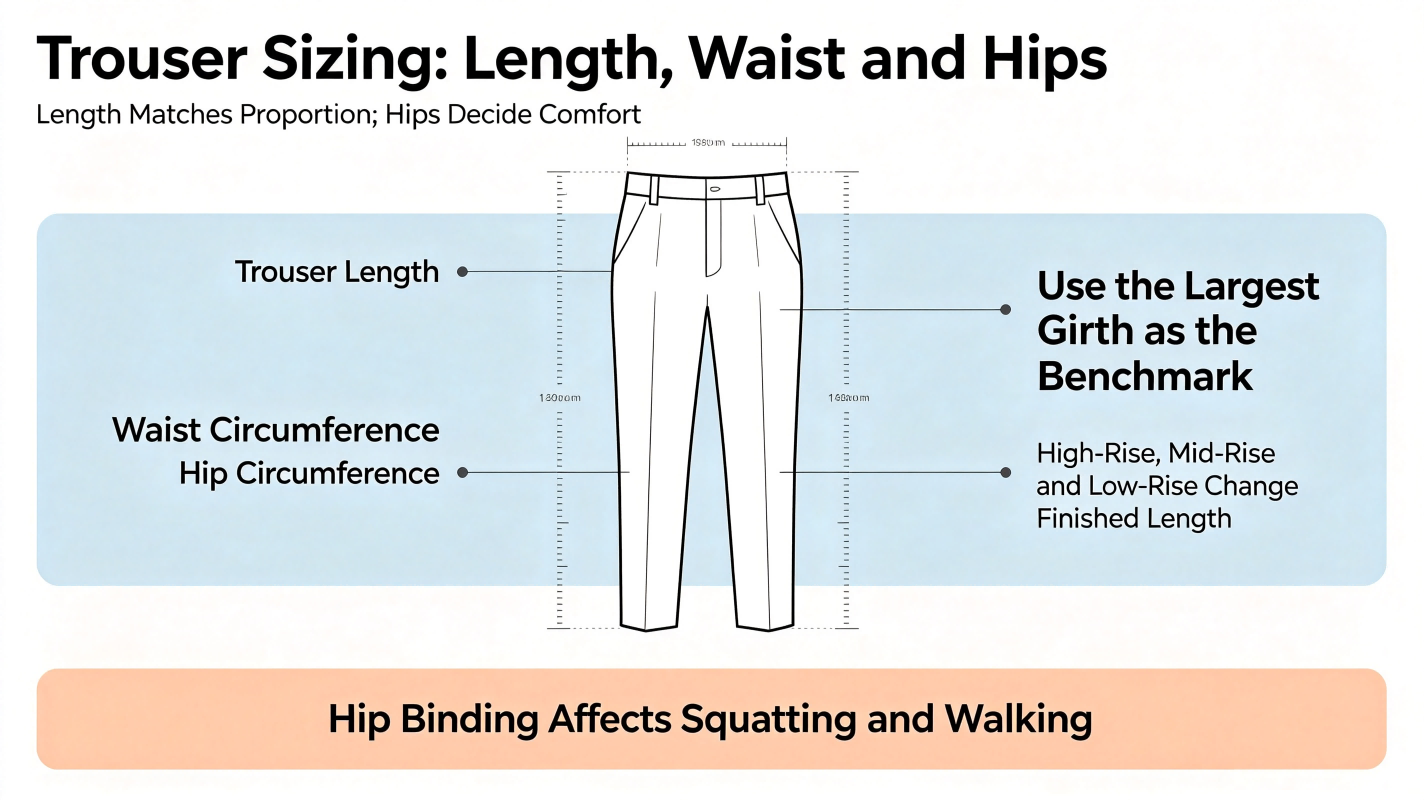
There is a rough rule of thumb: trouser length is about 55% to 60% of height. For example, for a height of 165 cm, trouser length would be between 91 cm and 99 cm. But nurse trousers come in high-rise, mid-rise, and low-rise versions. For the same height, the "finished trouser length" of high-rise and mid-rise trousers may differ by several centimetres.
A more practical judgment is: check whether the trouser length matches your "waist-to-ankle" length. If the size chart only gives trouser length and height without waist rise information, look for feedback from buyers of the same style – whether the trousers reach the ankle or drag on the floor.
Waist and hip circumference: use the "largest girth" as the benchmark, not the waist circumference.
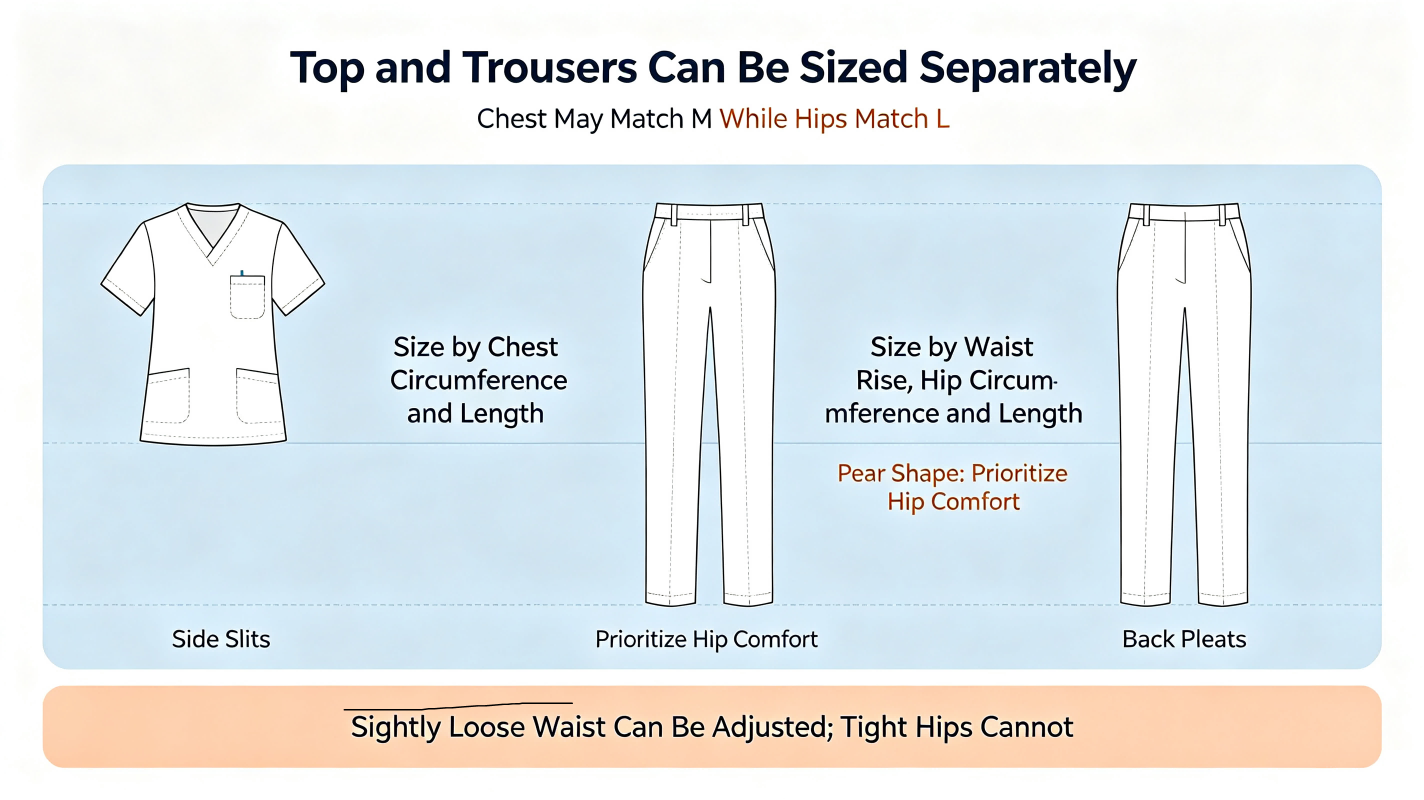
This is the most core rule for trouser sizing. Many people's waist and hip circumferences don't fall into the same size grade. Waist corresponds to M, hips correspond to L—which to choose? Choose L. A slightly large waist can be adjusted with a drawstring, belt, or pattern styling, but binding at the hips directly affects squatting and walking, and trousers have no stretch to "expand."
For pear-shaped figures, besides choosing the right size, the trouser style itself matters – side slits or back pleats can release hip pressure and are more effective than simply sizing up one.
4. How exactly should height and weight be used? Use them, but not only them
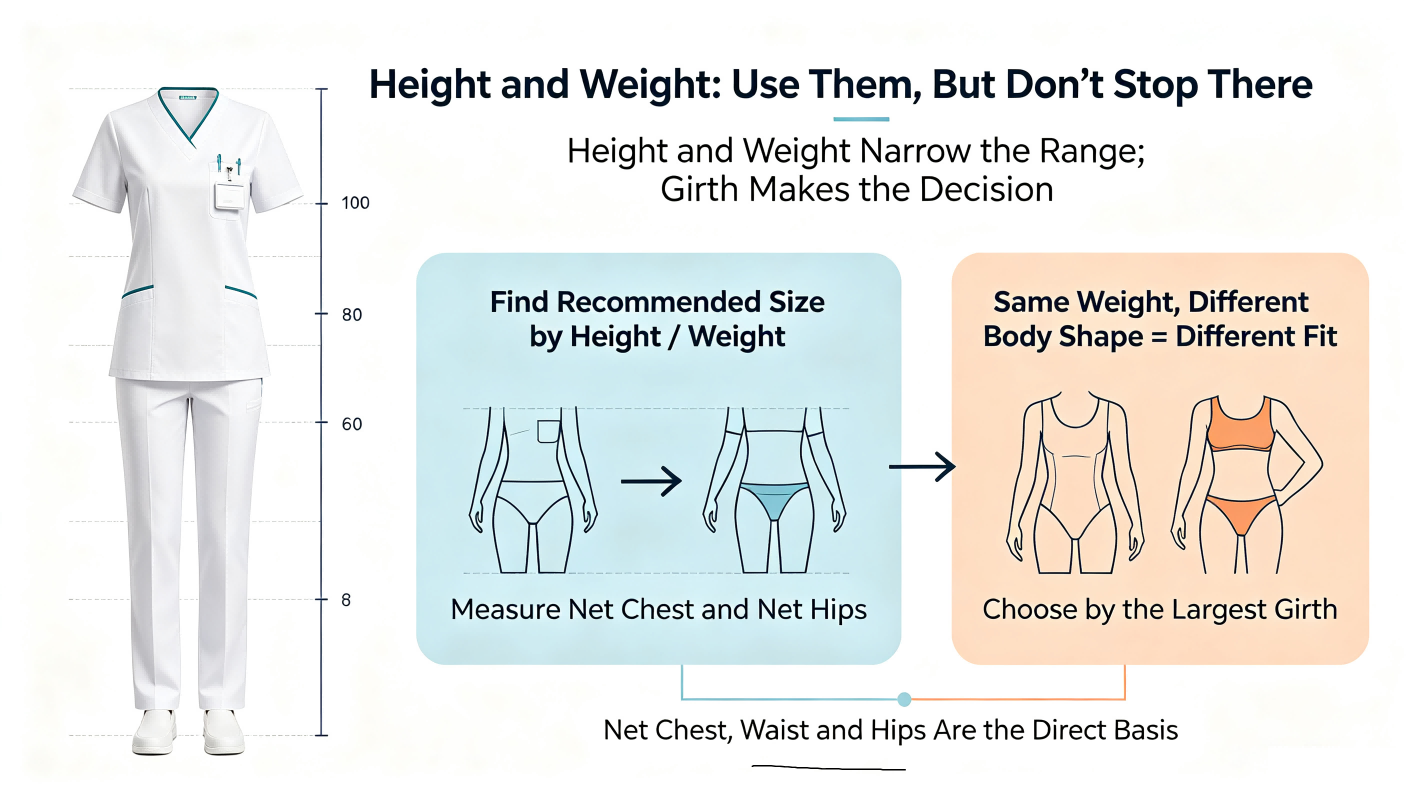
The "recommended height" and "recommended weight" on size charts are empirical ranges summarised by manufacturers based on data. Their role is to quickly narrow down the selection range, not to precisely determine the size.
Take a common reference table as an example: S corresponds to 155–160 cm and 45–55 kg, M to 160–165 cm and 55–65 kg, L to 165–170 cm and 60–65 kg, XL to above 170 cm and 65–70 kg. Different brands and different cuts may vary by 1–3 cm or even more.
When height and weight point to different sizes, girth measurements take priority. A person 165 cm tall and 70 kg – by height, they might fall into M; by weight, into L. At this point, measure net chest and net hip circumference; whichever girth corresponds to the larger size, choose that. The "recommended weight" on the size chart is only an indirect reference—net chest, net waist, and net hip circumference are the direct basis.
There's another easily overlooked point: at the same weight, muscular and fat body types differ greatly in girth. A 60 kg muscular person and a 60 kg heavier person may have completely different chest, waist, and hip circumferences, and react completely differently to the same size. Weight is only a starting point; girth is the endpoint.
5. Off-the-shelf procurement and custom-made follow different conversion logic
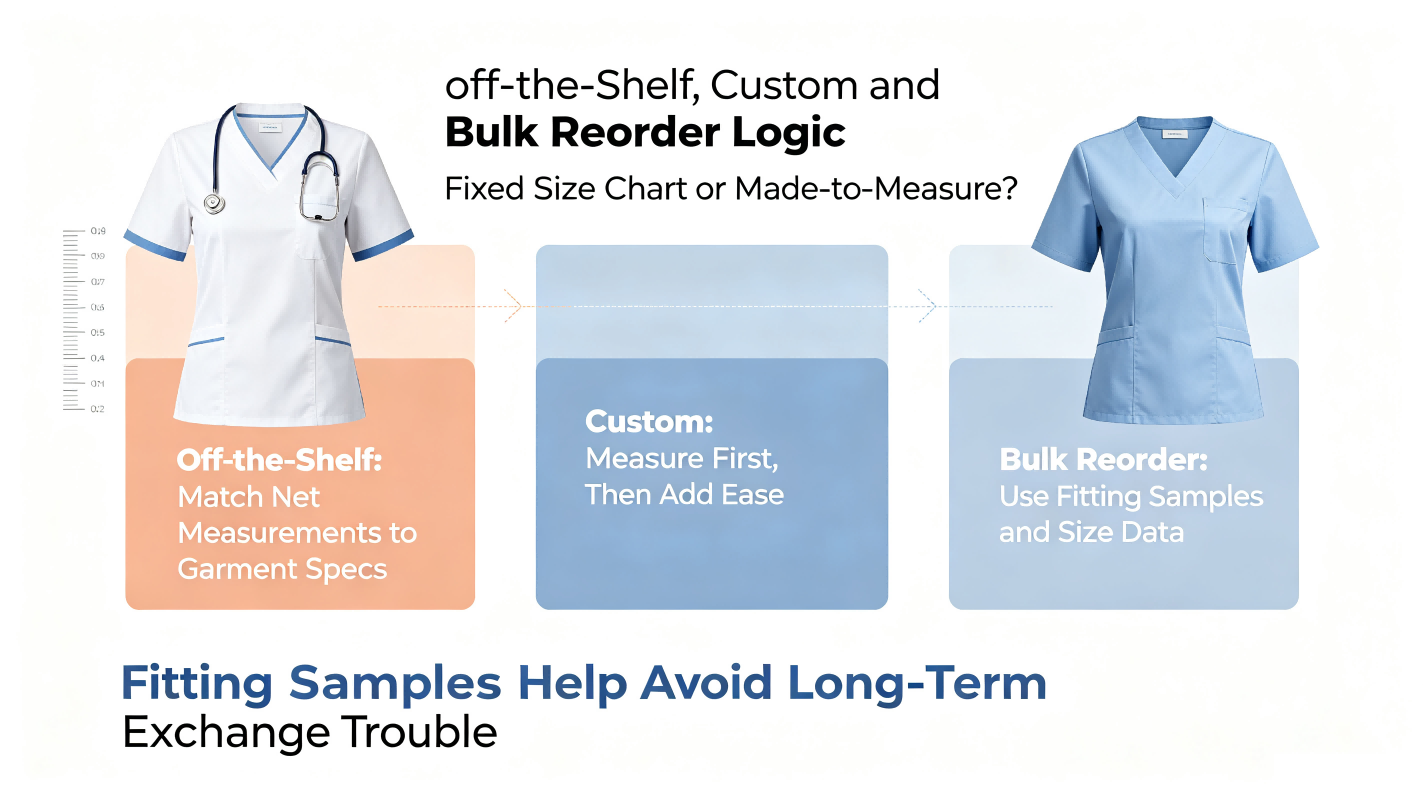
What we've discussed above is mainly the sizing logic for off-the-shelf nurse uniforms—you get a fixed size chart and match your net measurements to it.
If it's custom-made or measured procurement, the logic reverses: first measure net dimensions, then add ease according to fabric stretch and cut to generate garment measurements. The data collected during measuring is more detailed—some custom brands collect 19 body measurements and 26 key-area measurements, then confirm the wearing effect using fitting samples.
For institutions with bulk procurement and high staff turnover, there is also an intermediate solution: fitting samples + reorders. First, use a few standard sizes to let nurses of different body types try them on, determine each person's corresponding size, keep the data, and for subsequent reorders, simply order by size without re-measuring.
6. A table to make it clear: when you get a size chart, look at it in this order
|
Step |
What to look at |
How to use it |
|
Step 1 |
Garment chest circumference |
Subtract your net chest circumference. Stretch fabric difference 4–6 cm; non-stretch fabric 8–10 cm |
|
Step 2 |
Garment length |
Check whether it covers the hip line by at least 5 cm, combined with torso length |
|
Step 3 |
Shoulder width/armhole |
Check shoulder width data; if armhole depth isn't stated, look at pattern description |
|
Step 4 |
Trouser length |
Consider waist rise to judge where it reaches at the ankle |
|
Step 5 |
Waist/hip circumference |
Use the largest girth; hip circumference takes priority over waist |
|
Step 6 |
Height/weight columns |
Use to quickly narrow the range, not to determine precisely |
7. Three most common misreadings
Misreading 1: "I normally wear M, so I'll choose M for the nurse uniform too."
Nurse uniform cuts and everyday clothing are not the same system. Nurse uniforms are generally looser, and the M size of different brands may differ by several centimetres in garment chest circumference. "I normally wear M" cannot be used as a basis for choosing a size – the difference in garment chest circumference is what matters.
Misreading 2: "Just choose by height."
Height determines garment length, sleeve length, and trouser length, but not fit. Two people of the same height with a 10 cm difference in net chest circumference will look completely different in the same size. Height is used to double-check length; girth is used to determine fit.
Misreading 3: "The numbers on the size chart are precise values."
Garment measurements have tolerances. National standards generally allow deviations of ±1.0 cm to ±2.0 cm for garment specifications, with different tolerance ranges for different parts. Different fabrics and different batches of finished products also vary. The size chart is a reference, not a millimetre-precise promise.
A final honest word
A nurse uniform size chart is not a "height-weight look-up table" – it's a "table of differences between garment measurements and net measurements."
The key to understanding a size chart isn't memorising which height corresponds to which size – it's knowing three things: chest circumference looks at the difference, garment length looks at whether it covers the hip line, and trousers use the largest girth as the benchmark. Height and weight narrow the range; girth makes the final decision. Stretch fabric leaves 4–6 cm; non-stretch fabric leaves 8–10 cm; pure cotton versions factor in shrinkage.
Next time you get a nurse uniform size chart, don't first look for "how tall am I." First find "garment chest circumference" and "garment hip circumference," subtract your net measurements, and see which range the difference falls into – that's far more reliable than guessing from height and weight.