What Are You Looking For?



Introduction
For B2B buyers, anti-static workwear isn’t just about comfort—it’s about safety, compliance, and protecting multi-million-dollar equipment. Whether you’re equipping a semiconductor cleanroom or an oil refinery, understanding the difference between ESD and anti-static protection, and which certifications matter, is critical. This guide covers the key standards, performance parameters, and sourcing pitfalls—so you can order with confidence from a manufacturer like Golden Shield that meets both global and China-specific requirements.
1. ESD vs. Anti-Static: Two Different Goals
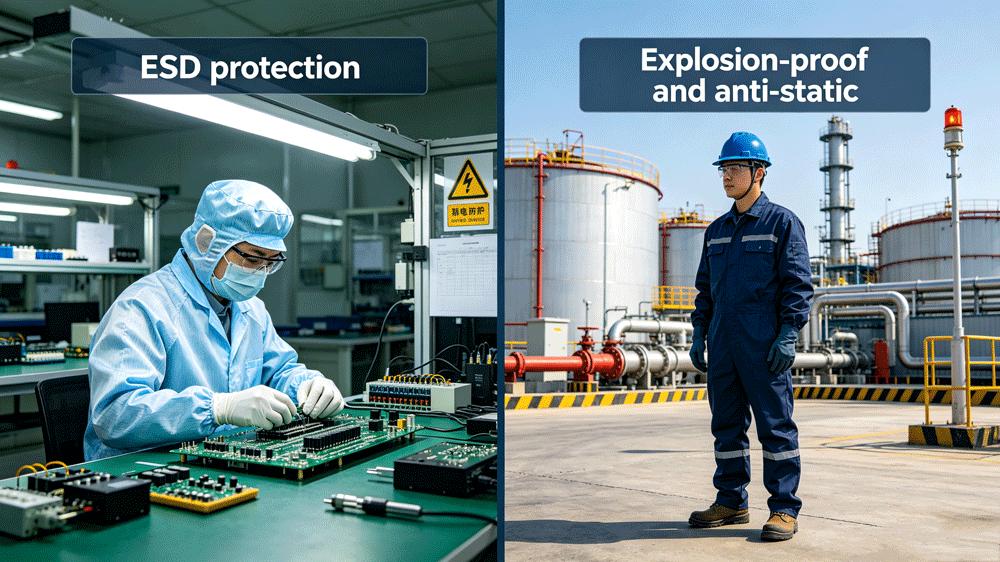
Static control falls into two distinct categories, and using the wrong one can be catastrophic.
ESD Control (Electronics Protection) – Designed to protect sensitive components from static discharge. Typical standards: IEC 61340-5-1, ANSI/ESD S20.20. Used in semiconductor, PCB assembly, and microelectronics industries.
Anti-Static / Explosion Prevention – Designed to prevent sparks in flammable atmospheres. Key standard: EN 1149-5, ATEX directive. Required in petrochemical, gas, paint spraying, and grain handling facilities.
2. Mandatory Certifications You Must Verify
Do not accept a supplier’s word alone. Always request third-party test reports from accredited labs (CMA/CNAS for China, or equivalent for international standards).
| Standard | Application | Application | |
| EN 1149-5 | EU explosive atmospheres | Surface resistivity ≤ 2.5×10⁹ Ω, charge decay test | |
| IEC 61340-5-1 | Global ESD control | Garment must be part of an EPA (Electrostatic Protected Area) | |
| ANSI/ESD S20.20 | North America ESD | Foundation for ESD control programs in electronics | |
| GB 12014-2009 | China mandatory | Defines A-level (explosive, 10⁵~10⁷Ω) and B-level (electronics, 10⁷~10¹¹Ω); charge density ≤7μC/m² |
Golden Shield provides full CMA/CNAS-accredited test reports for every batch, with data on surface resistance, charge density, and wash durability.
Performance Parameters That Matter
When comparing suppliers, focus on these measurable values:
Surface Resistance (Point-to-Point) – Must fall between 10⁵ and 10¹¹ Ω. A-level (high-risk) requires 10⁵~10⁷ Ω; B-level allows 10⁷~10¹¹ Ω. Too low can cause leakage; too high won’t dissipate static.
Charge Surface Density – ≤7μC/m² per GB 12014. High-end electronics often demand even lower (e.g., <0.6 μC).
Static Decay Time – Top-quality fabrics dissipate static in under 2 seconds, crucial for dynamic operations.
Wash Durability – Look for fabrics that maintain conductivity after 50–100 industrial washes. Avoid topical chemical coatings that wash out.
4. Fabric Construction: Permanent Performance vs. Coating
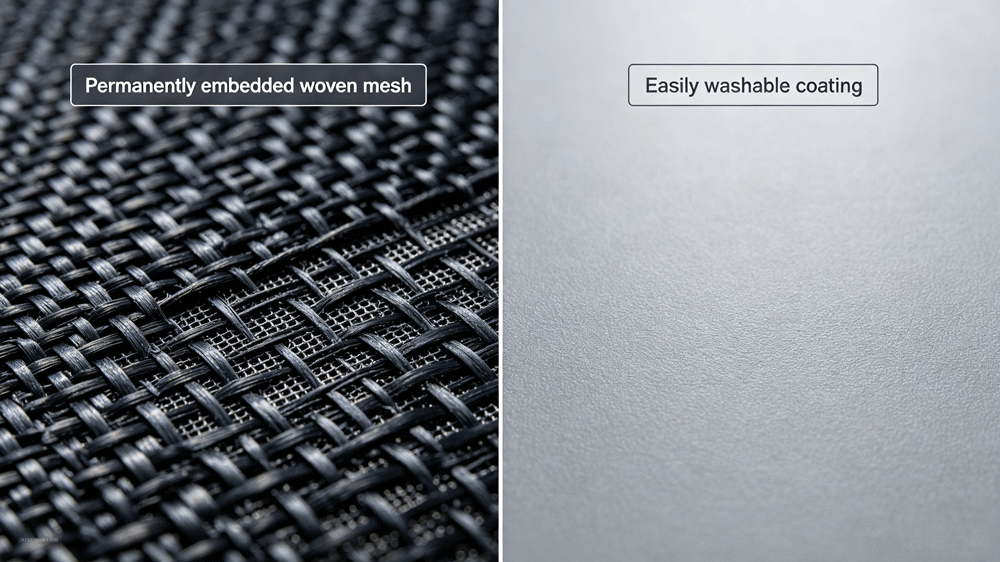
Anti-static properties must be built into the fabric structure, not just coated on.
Permanent Carbon Filament Weave – Conductive carbon fibers are woven into the base fabric (typically polyester/carbon blend) in a grid or stripe pattern. This provides lasting static dissipation.
Grid vs. Stripe – A grid pattern (both directions) offers multi-directional protection for cleanrooms and electronics. A stripe may suffice for general warehousing but is insufficient for high-risk ESD zones.
Avoid Topical Agents – Chemical anti-static finishes degrade after a few washes. Always verify that the conductive yarn is embedded, not just applied.
Golden Shield uses grid-weave carbon filament technology at 5mm spacing, ensuring permanent performance and compliance with the strictest cleanroom requirements.
B2B Procurement Checklist
Use this checklist to avoid substandard products:
Confirm standard applicability – EN 1149-5 for explosive areas, IEC/ANSI for electronics, GB 12014-2009 for China domestic/export.
Request third-party batch test reports – with CMA/CNAS stamp, less than 1 year old.
Check component continuity – zippers, buttons, thread, and cuffs must also be conductive or dissipative.
Verify wash test data – resistance should hold through at least 50 industrial washes.
Inspect garment construction – no broken conductive yarns, clean seams, correct labeling.
Remember the system – anti-static clothing works only with conductive footwear, wrist straps, and grounded flooring.
Golden Shield is not just a supplier, but also a reliable pillar in your supply chain system. We help purchasing managers improve supply chain resilience and ensure stable operations by building a solid industrial chain, transparent management processes and collaborative and innovative cooperation models.
Golden Shield - Your Reliable Supply Chain Partner
WhatsApp: + 86 133 7788 3692
Email: [email protected]